keypoint of these blog
- BIM is one of the best Non coding courses you can choose after 12th, offering a high demand skill-based career path that doesn’t require a degree or programming background.
- It focuses on practical construction workflows, coordination, and digital project delivery.
- Students can become job-ready in a shorter time compared to traditional degree paths.
- BIM skills enable early entry into internships and entry-level industry roles.
- Learning BIM builds strong visualization and problem-solving abilities.
- Flexible learning options like BIM classes and online BIM certificate programs support early upskilling.
- BIM offers global career opportunities due to standardized tools and workflows.
- Career growth extends from modeling roles to coordination and management positions.
- BIM supports long-term career stability in construction and infrastructure.
- Early BIM learning helps students gain clarity, confidence, and a competitive edge.
Why Students Are Looking Beyond Degrees and Coding
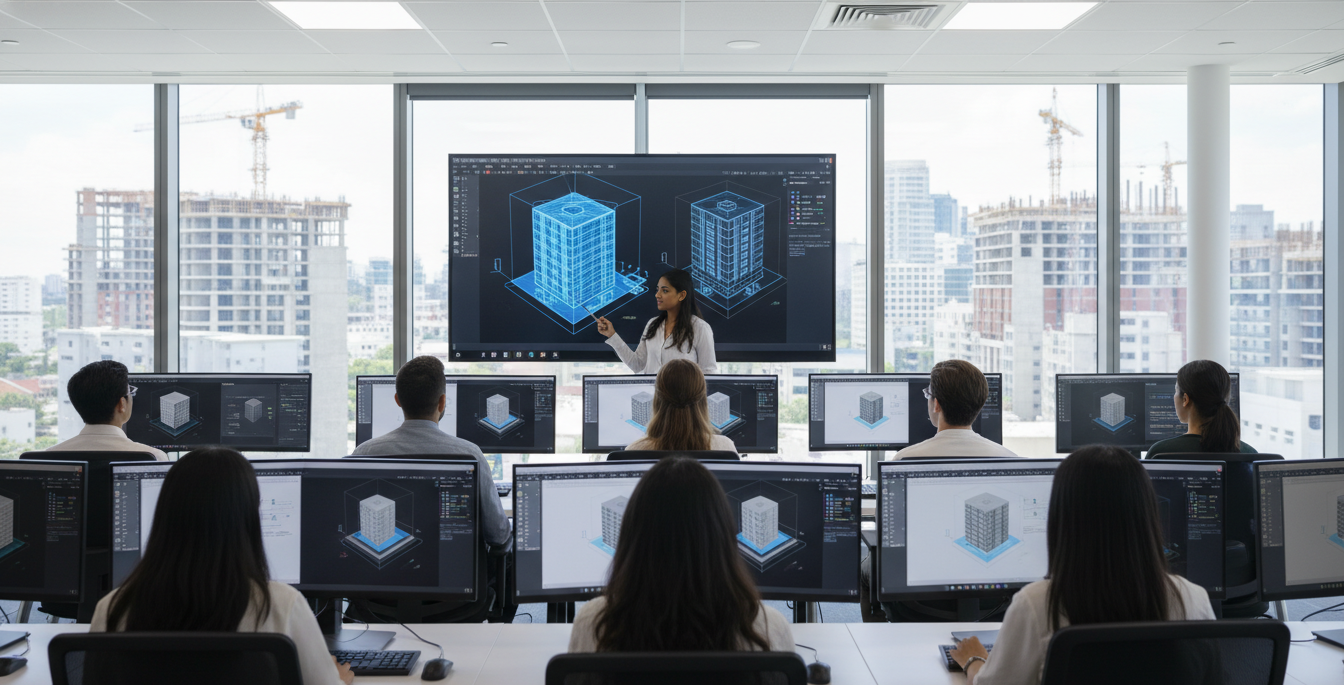
The students of today are much more conscious about the changes that are taking place in the job market as compared to the last generation. They have witnessed how students are struggling to get a job related to their field of interest even after spending so many years in education. At the same time, coding, which was considered a “safe” and secure career option, is no longer the best choice for everyone. Not all students are interested in coding or want to spend the entire day coding. Thus, after the completion of 12th grade, students are in search of industry-related options like Non coding courses that will help them gain relevant skills and enter them into the job market.
Another important reason for students taking on more than degrees and programming is the desire for earlier career clarity. Traditional educational pathways often put off the exposure to work-related experience until the end of the course. However, learning based on skills lets students understand how industries work from the very beginning. Industries that deal with infrastructure, construction as well as digital designs are becoming increasingly appealing because they blend technological knowledge with tangible real-world results. This is why BIM is a powerful alternative. With BIM classes, pupils are able to understand how buildings are designed and coordinated digitally. This allows them to determine if this field is suitable for them prior to choosing the long-term path of study.
Students are also affected by the increased selection of formal learning opportunities which focus on being employable. Through the online BIM certificate programs , students are able to begin developing work-ready skills as soon as they have completed 12th grade. The programmes are created to teach the industry tools standardization, workflows, and standards rather than abstract concepts. Unlike programming, which often demands constant updates in languages and complex abstract logic, BIM is one of the most practical non coding courses that focuses on visualization, coordination, and real-world problem solving within construction projects. This balancing act between technology and practicality is the reason why many students consider BIM as a better and more rooted skill to pursue in the evenings after school.
BIM vs Degree-Based Careers
| Aspect | BIM-Based Career Path | Degree-Based Career Path |
| Time to Employability | Job-ready within months through focused training | Usually 3–5 years before industry readiness |
| Learning Approach | Practical, skill-based, and project-oriented | Theory-heavy with limited early practical exposure |
| Industry Exposure | Early exposure through real project modeling and coordination | Often delayed until internships or final years |
| Cost of Learning | Generally lower with flexible course options | Higher due to tuition, exams, and extended duration |
| Flexibility | Can be learned alongside college or diploma studies | Requires full-time academic commitment |
| Skill Relevance | Directly aligned with current industry workflows | May require additional skill training after graduation |
| Job Roles at Entry Level | BIM Modeler, Junior Coordinator, Design Support | Graduate Engineer, Trainee Engineer |
| Global Opportunities | High due to standardized BIM tools and practices | Varies by degree recognition and licensing |
| Career Growth | Grows into coordination, management, and digital roles | Growth depends on experience plus additional skills |
| Dependence on Academic Scores | Portfolio and skills matter more | Academic performance plays a major role |
How BIM high demand Skills Create Early Career Opportunities
One of the most significant benefits of studying BIM after the 12th grade is the possibility of gaining access to job opportunities sooner than conventional methods. BIM expertise is directly tied to the execution of projects so even the simplest learners can be a part of actual work. Students who are trained in BIM are able to assist in modeling as well as documentation and coordination tasks that are vital to contemporary construction projects. Early involvement helps students gain confidence and gives them an experience in the field that sets them apart from their peers who have only academic expertise.
Employers are looking for candidates who know digital workflows and who can assist teams of project managers from the start. Students who have been trained in BIM are typically able to take on positions like junior BIM modeler or trainee coordinator designer support manager. These roles do not need years of experience, but require a certain level of skill and precision. With BIM classes, participants will learn how to use drawings models, as well as shared data environments, which makes them valuable contributors from the beginning. This is particularly beneficial for those who wish to gain experience, work as an intern or make a name for themselves while continuing their education.
Career opportunities for young professionals also grow internationally when students take part in specific training programs like online BIM certificate programs. Numerous construction firms across the world have similar BIM standards that means the skills can be transferred across industries. Civil-focused students who select to take the Best BIM course for civil engineers are often able to find jobs to work in consulting businesses, projects for infrastructure or contractor-related offices. By establishing an impressive portfolio of BIM work before they start students can avoid relying on lengthy academic timelines and can provide multiple entry points to the business. This ability to begin with a small amount of learning on the job and then grow in a steady manner is what makes BIM an excellent career accelerator following the 12th.
Demand for Practical and Job-Oriented Skills
The job market of today puts greater emphasis on the skills one can do than the degree they have. Employers across all industries are focusing on the ability to solve problems, practical skills and a familiarity with actual workflows. In the field of infrastructure and construction this trend is more apparent because of the complexity of projects as well as the strict time frames for delivery. BIM works perfectly with this scenario because it is fundamentally practical and project-oriented. Students learn through doing rather than just studying or memorizing ideas.
BIM helps students understand how engineering, design and construction teams collaborate digitally to prevent errors and delays. This knowledge is hard to attain by merely attending classes in traditional schools. Through attending BIM classes, participants get the ability to work with drawings, models and coordination techniques which are in line with the expectations of industry. This ensures they are job-ready, and lessens the burden of training for employers. In turn, employers are actively looking for candidates who have BIM exposure even for roles that are junior.
The need for practical skills is also a major driver behind the growth of the online BIM certificate programs that are specifically designed to meet the demands of industry. These programs are focused on proficiency in software standards, real-world scenarios instead of general theory. For students in civil engineering, registering in the Best BIM course for civil engineers will help to bridge the gap between academic study and practical work. Instead of having to adjust following graduation, students who master BIM early can enter the workforce in a confident and clear manner. This alignment with skills that are relevant to the job is a major motive BIM keeps gaining traction in the minds of students after the 12th grade.
Long-Term Growth using BIM as a skill
Although BIM has significant advantages for early career It isn’t limited to entry-level positions. One of the major advantages that comes from BIM is its ability to grow over time. As professionals advance in their careers, BIM skills evolve from basic modeling to coordination management, strategic roles. This allows them to create a long-lasting career without changing fields. BIM professionals usually advance to posts like BIM coordinator, BIM engineer or BIM manager, in which leadership and decision-making take on a greater role.
The long-term growth of BIM is tightly tied to the latest trends in industry like sustainability, digital construction and intelligent infrastructure. As projects get more complicated as they become more complex, the need for highly skilled BIM professionals grows. Continuous education through advanced BIM classes helps professionals stay relevant and climb the ladder of career advancement. People who begin early can develop their skills, comprehend standards and develop solid portfolios that give them an edge in higher-level jobs later.
Global demand is further bolstering BIM’s long-term prospects. Professionals trained via the online BIM certificate programs typically discover opportunities across different regions because of standardized processes and tools. Professionals with a focus on civil engineering who start by taking the best BIM course for civil engineers may later focus on transportation, infrastructure or large-scale development. This flexibility lets BIM professionals to adjust to the changing needs of the market while ensuring stability in their careers. In contrast to other skills for short-term use, BIM continues to grow in importance, making it a long-term, reliable career investment.
MUST READ
Advance Your Career with the Complete Online BIM Program
Getting Started with BIM After 12th
Steps to Get Started with High Demand Skill After 12th
- Understand What BIM Is
Learn the basics of Building Information Modeling and how it is used in real construction projects for design, coordination, and planning. - Check Your Eligibility
Make sure you have completed 12th grade. BIM is one of the most practical Non coding courses, and you don’t need an engineering degree or any coding background to get started. - Learn Construction Fundamentals
Get familiar with basic building components, drawings, and construction terminology before moving into software. - Choose the Right BIM Course
Select a beginner-friendly BIM course that focuses on practical learning, real projects, and industry standards. - Start with BIM Software Basics
Begin learning tools like Revit for modeling and documentation through guided, hands-on practice. - Practice with Small Projects
Apply what you learn by working on simple residential or commercial building models to build confidence. - Develop a BIM Portfolio
Create a portfolio showcasing your models, drawings, and coordination work to demonstrate your skills. - Learn Coordination and Standards
Understand basic coordination concepts, drawing standards, and how teams collaborate on BIM projects. - Explore Entry-Level BIM Roles
Look for trainee or junior BIM roles to gain industry exposure while continuing your education. - Keep Upgrading Your Skills
Continue learning advanced BIM tools, workflows, and industry practices to grow in your career.
The sector of infrastructure and construction is moving swiftly towards digital transformation. Building Information Modeling (BIM) is at the forefront of this change. If you’re an architect, engineer, or construction professional, getting a hands-on understanding of BIM is now vital. Participating in a full BIM course online is a great move towards becoming a BIM-certified professional and ensuring your business remains on top in the AEC sector.
FAQs for Students Exploring Career Options After Intermediate
- Are there career options after 12th that don’t require a degree or coding?
Yes. One such option is learning a practical construction technology skill known as BIM (Building Information Modeling). It focuses on real project work rather than long academic study or programming. - What kind of work do these practical construction skills involve?
They involve digitally planning buildings, creating drawings, coordinating design information, and supporting construction projects. This entire digital workflow is commonly done using BIM tools and processes in the industry. - Is this type of career suitable for beginners with no technical background?
Yes. BIM learning starts from basics, and students do not need prior engineering knowledge or work experience to begin. - Who should consider this option after intermediate?
Students interested in buildings, design, planning, or hands-on technical work can consider this path. Many students from science backgrounds choose BIM-related training after 12th. - Do I need strong math skills or coding knowledge?
No, BIM does not require coding. In fact, it is a practical non coding course, and a basic understanding of mathematics is more than enough for beginners to get started. - How is this different from regular college education?
Traditional education is theory-focused, while BIM training is practical and project-based, teaching how real construction projects are executed digitally. - Can this help me get a job or internship early?
Yes. Students with basic BIM high demand skills can apply for trainee roles, internships, and junior positions in construction and design companies. - What kind of companies use these skills?
Construction firms, architecture studios, engineering consultancies, and infrastructure companies actively use BIM workflows in daily project execution. - How long does it take to learn these skills after 12th?
Basic BIM skills can be learned within a few months, depending on practice and course structure. - Is this a short-term skill or a long-term career option?
It is a long-term career path. With experience, BIM professionals grow into coordination, management, and leadership roles. - Can I learn this while studying in college?
Yes. Many students learn BIM alongside their diploma or degree to improve job readiness and confidence. - What is the first step to start learning this field?
The first step is to understand how modern buildings are planned digitally and then enroll in beginner-level BIM classes that focus on practical training.