The development of infrastructure in India is expanding at a rapid rate. Highways, roads, railway lines, cities with smart technology along with water infrastructure are growing all over the country. In this context precision, speed of design and coordination, are not an option. This is the reason why Civil 3D is now a vital tool. Professionals who want to remain current, knowing what Civil 3D fits into BIM for Civil Engineers is critical. In addition, registering in an BIM course with placement is now seen as an effective step toward building an industry-ready career.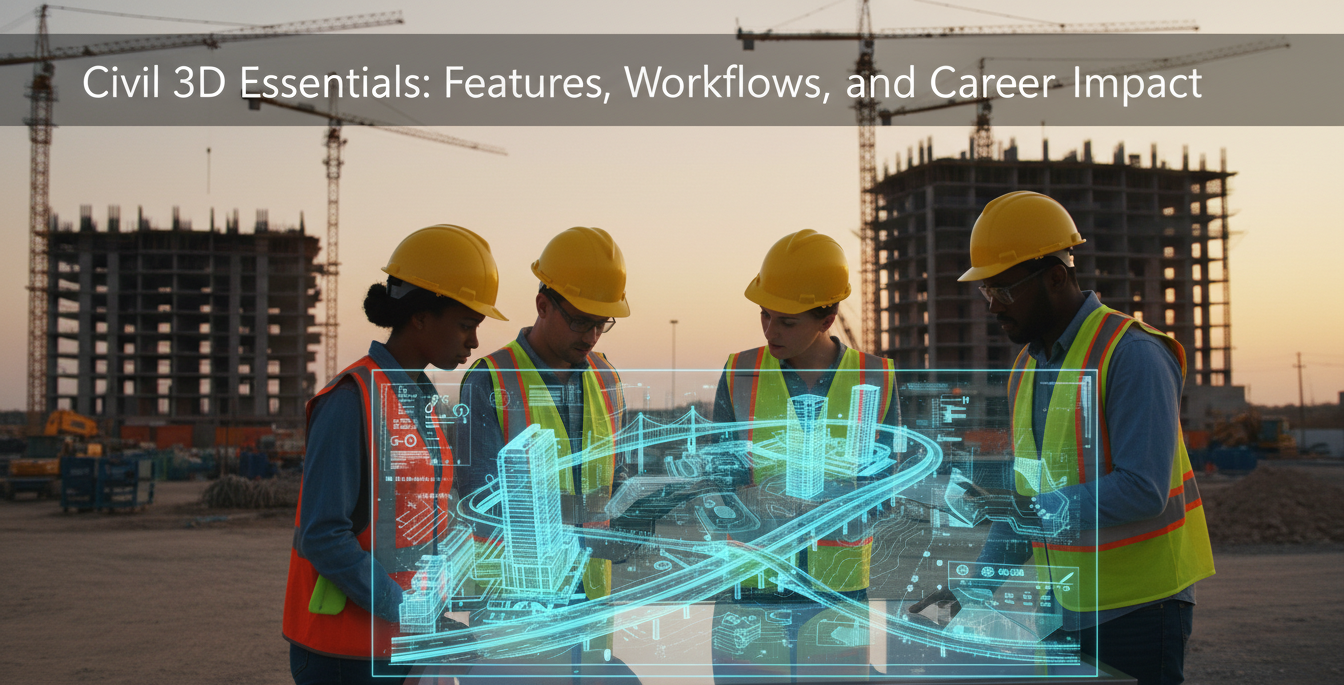
What is it that makes Civil 3D Essentials different from other Design Tools?
Civil 3D is not just software for drawing. It is a design tool based on models designed specifically in the field of civil infrastructure. Contrary to conventional CAD, Civil 3D works using intelligent objects like the alignment of surfaces, walls, pipes, corridors, and networks. If one element is changed the related elements update automatically.
This dynamic behavior is in perfect alignment to BIM for Civil Engineers, which focuses on connecting data, not isolated drawings. Professionals who are aware of this shift are better prepared to deal with the complexity of real-world projects. A BIM course with placement usually exposes students to these concepts early, allowing them to adapt quicker to the demands of industry.
Core Features That Support Infrastructure Design
Civil 3D supports the complete cycle of design and construction. From the import of survey data through the final drawings of construction all of it happens within an integrated environment. Designers can simulate existing ground conditions, alternative designs and assess the results without reworking tasks.
For Indian projects in which design revisions occur frequently due to the site’s conditions and approvals the flexibility of this model is vital. BIM for Civil Engineers relies heavily on these intelligent workflows along with Civil 3D forms the backbone for highways, roads, and land development models.
Surfaces, Alignments, and Corridors
Surfaces contain information about terrain while alignments define the road’s center lines and corridors produce 3D road models. All of these elements are integrated within Civil 3D, allowing engineers to visualize and refine their designs swiftly. This interconnected system demonstrates how Civil 3D enhances BIM Workflows, reducing mistakes and reducing time.
Professionals who are trained in the BIM course with placement will learn about how the components interact by exposing them to the industry’s standard practices.
Civil 3D Workflows in Real Projects
The workflow for civil 3D follows a natural sequence that is similar to the real-world projects. Survey data is converted into surface, design alignments are made and corridors are designed to allow for precise modelling. Profiles, quantities, and sections are created automatically using the model.
This model-driven workflow is a great complement to BIM for Civil Engineers by making sure that drawings are consistent across data outputs. Instead of manually updating several files, engineers can rely on the model as a single point of truth. This method improves collaboration with different disciplines, and helps reduce the need for rework in construction.
Integration with BIM and Multidisciplinary Teams
Infrastructure projects rarely involve only civil engineers. Planners, structural engineers, and contractors all depend on sharing information. Civil 3D integrates with broader BIM platforms, which allows information exchange and collaboration.
This integration demonstrates why BIM for Civil Engineers is not just for building projects. Land development and infrastructure that is linear can also benefit from BIM principles. A BIM course with placement typically includes these aspects of coordination and prepares students to be part of multidisciplinary teams.
In design discussions, the best Civil Engineering Quotes typically emphasize the importance of precision, accountability and the long-term effects. Civil 3D supports these values through accurate modelling and an informed decision-making process.
Automation and Efficiency in Design Tasks
One of the greatest benefits that comes with Civil 3D is its automation. The cross-section designs are all automated using the model. This helps reduce manual effort and minimizes human errors.
Automation is a crucial element when it comes to BIM for Civil Engineers, especially in large-scale projects where even a small error can cause significant delays. Understanding these automated workflows in the BIM course with placement helps professionals produce faster and more secure results.
Career Impact of Learning Civil 3D
The ability to use 3D in civil engineering significantly increases career opportunities for civil engineers. Employers are looking for people who can make a difference right from the start and modeling-based design abilities can be a major advantage.
Professionals who are knowledgeable about BIM for Civil Engineers and Civil 3D often find opportunities in infrastructure consulting firms, EPC firms, and government projects. Successfully completing the BIM course with placement component adds more value because it combines the technical education with exposure to industry.
Indian Industry Demand and Skill Expectations
India’s emphasis on metro rail, highways, and urban development has led to a higher the demand for Civil 3D experts. Companies expect engineers to be aware of the design intention and workflows that are digital.
This is the reason BIM for Civil Engineers is becoming a mandatory requirement instead of a specialization. A planned BIM course with placement can help in bridging that gap in academic knowledge and the expectations of industry, particularly for recent graduates and professionals in early stages of their careers.
From Design Office to Construction Site
Civil 3D models aren’t only for design offices. They are becoming increasingly utilized on construction sites to plan quantification, planning, and tracking progress. Contractors depend on precise models to efficiently complete work.
Understanding how models change from concept to implementation is an important aspect for BIM to Civil Engineers. This understanding is usually strengthened by project-based learning during BIM course with placement.
Long-Term Growth and Professional Relevance
The process of learning Civil 3D is not just about finding work. It can help you grow over the long term by creating a solid digital base. As infrastructure projects grow more complicated and complex, model-based workflows will continue to be the most popular.
Civil Engineers who take part on BIM for Civil Engineers today are positioned as the next leaders. A BIM course with placement speeds the process by combining knowledge confidence,and industry ability.
Conclusion
Civil 3D has become an indispensable tool in modern design of infrastructure. Its sophisticated capabilities, automated workflows, and BIM Integration make it extremely appropriate for today’s civil engineers. When integrated in conjunction with BIM for Civil Engineers, Civil 3D supports accuracy, efficiency and collaboration across the project’s phases.
If you’re thinking of to pursue a career in infrastructure, acquiring Civil 3D through a BIM course with placement is an investment worth making. It doesn’t just enhance technical capabilities, but also increases employment opportunities in India’s rapidly expanding construction industry. As the construction industry develops, Civil 3D will remain an important driver of digital technological advancement to civil engineers.
Frequently Ask Question
- What is Civil 3D and how is it different from traditional CAD software?
Civil 3D is a design tool specifically for civil infrastructure that uses intelligent objects such as surfaces, alignments, corridors, and networks. Unlike conventional CAD, if one element is modified, related elements update automatically, enabling dynamic and accurate design workflows.
- Why is Civil 3D important for civil engineers in India?
With India’s rapid infrastructure growth—highways, metro rails, urban development, and water projects—Civil 3D ensures precision, speed, and coordinated design. Engineers skilled in Civil 3D can handle complex projects efficiently.
- How does Civil 3D support BIM workflows?
Civil 3D integrates with BIM for Civil Engineers by connecting data across project components, enabling accurate model-based designs, collaboration across disciplines, and reducing the need for rework.
- What are the core features of Civil 3D?
Key features include surface modeling, alignment creation, corridor design, automated cross-sections and quantity calculations, integration with survey data, and support for end-to-end infrastructure design and construction.
- How does Civil 3D improve workflow efficiency on projects?
By using model-driven workflows, Civil 3D automatically updates related design elements, maintains consistency across outputs, reduces manual errors, and allows engineers to quickly test design alternatives.
- Can Civil 3D be used outside the design office?
Yes, Civil 3D models are increasingly used on construction sites for quantification, planning, and progress tracking, making them valuable for both engineers and contractors.
- What career advantages does learning Civil 3D offer?
Proficiency in Civil 3D increases employability in infrastructure consulting, EPC firms, and government projects. Coupling it with a BIM course with placement enhances practical industry readiness and exposure.
- Why is BIM knowledge important for Civil 3D professionals?
BIM knowledge enables civil engineers to collaborate effectively with multidisciplinary teams, manage design data efficiently, and align with modern digital workflows in large-scale infrastructure projects.
- How does Civil 3D handle design revisions?
Civil 3D’s intelligent modeling allows design changes to automatically update all related elements, ensuring flexibility in adapting to site conditions, approvals, and regulatory requirements without redoing manual work.
- Is learning Civil 3D relevant for long-term career growth?
Yes. As infrastructure projects become more complex, engineers with Civil 3D and BIM skills are positioned for leadership roles, with expertise in automated, model-based workflows becoming increasingly critical in the industry.