Surveying is a vital element when it comes to civil engineering, the development of infrastructure and construction. In the array of instruments used to survey the theodolite has the top spot due to its precision and flexibility. From the measurement of angles for road alignments to laying out high-rise buildings, is still a key instrument in the modern practice of surveying. In this thorough guide, we’ll be able to understand the meaning of types, techniques of use, the applications, benefits, and disadvantages of theodolite surveying in a systematic and practical way.
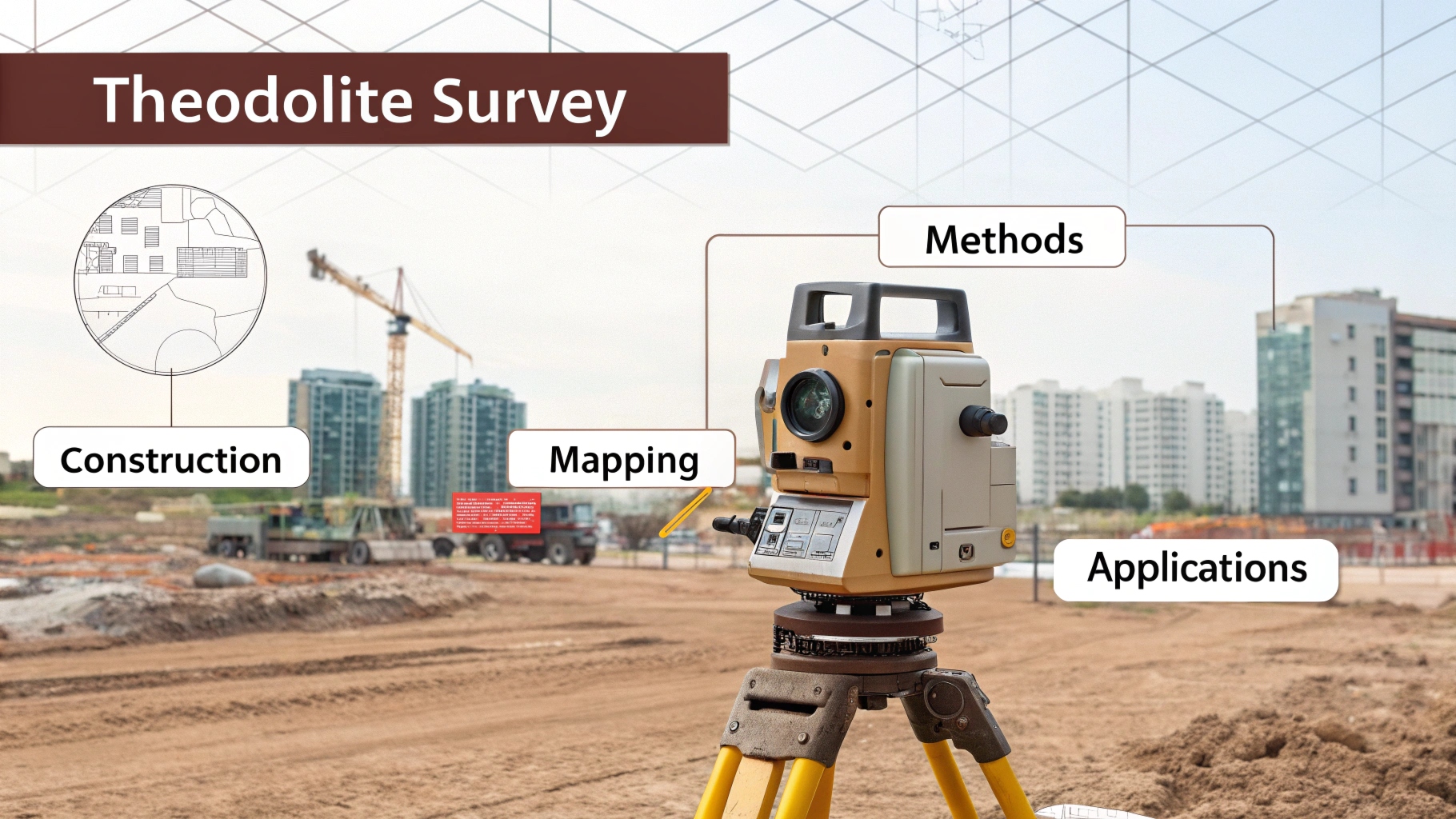
Definition of Theodolite Survey
The term “theodolite survey” refers to a Theodolite Survey is a surveying technique that is used to determine vertical and horizontal angles with the aid of a precise instrument known as a Theodolite. The device is comprised of an instrument that is mounted on a base rotating which allows for the movement of both vertical and horizontal planes. Through precise measurement of angles between points, surveyors are able to determine distances, elevations and precise locations in the earth. This method is commonly employed for civil engineering work where exact alignment and angular precision is essential to ensure the safety and efficiency of construction.
The Theodolite Survey is widely used for construction layout and triangulation. It is also used for traversing and alignment for railways, bridges, roads and high-rise structures. In spite of the widespread availability of total stations and GPS devices, the technique is still useful because precise measurements of angular angle directly impact the stability of structures. In the field of civil engineering students are taught Theodolite survey techniques to establish solid foundations. Professionals who progress through the BIM professional training course depend on these fundamental surveying techniques to understand the field data accurately and to integrate it into digital models.
For large-scale architectural projects, such as iconic structures such as tower C Redefines mixed-use Skyscrapers The precise surveying plays an essential role prior to any architectural or structural modeling gets underway. The accuracy of field measurements assures that digital models are based on real-world conditions. The relationship with field measurement and the digital process demonstrates the importance of acquiring traditional techniques of surveying alongside the latest tools.
The most important points about Theodolite Survey Definition
- Determines vertical and horizontal angles with precision
- It is used in triangulation, traversing and alignment
- Critical for construction and infrastructure layout
- Offers greater precision than compass surveying
Types of Theodolite
- Transit Theodolite – Telescope rotates fully in the vertical plane; widely used and more flexible.
- Non-Transit Theodolite – Telescope has limited vertical rotation; less common today.
- Mechanical (Vernier) Theodolite – Uses graduated circles and manual angle reading; chances of human error are higher.
- Digital Theodolite – Displays angles electronically; more accurate, faster, and efficient.
- Optical Theodolite – Suitable for basic surveying and educational purposes.
- Electronic Theodolite – Used for high-precision engineering projects.
- Total Station – Advanced instrument combining theodolite and electronic distance measurement for higher efficiency.
A Comparison Table for Theodolite Types
| Theodolite is a type of theodolite | Key Features | Accuracy Level | Common Use |
| Theodolite from Transit | Full vertical rotation | High | General surveying |
| Non-Transit Theodolite | The vertical movement is limited. | Moderate | Basic measurements |
| Digital Theodolite | Electronic angle display | Very High | Infrastructure projects |
| Electronic Theodolite | Digital systems integrated | Very High | Precision engineering |
Methods of the Theodolite Survey
The process of a Theodolite survey is carried out using techniques such as triangulation, traversing repetition, and reiteration depending on the requirements of the project. Triangulation is a system of triangles in order to determine the positions of vast areas. Traversing calculates a sequence of lines and angles and is typically used for roads, border surveys and pipelines. The technique of repetition increases precision by taking the same angle many times. It also allows for reiteration of multiple angles around a single location to minimize the chance of errors.
Each technique ensures exact alignment and layout for infrastructure projects. Professionals who take an BIM-related professional course utilize these concepts in the creation of aligning models for digital use. Students taking the BIM online certification course are also taught what the Theodolite Survey data transforms into precise digital models to aid in collaboration and implementation.
Key Methods Summary
- Triangulation for large-area control
- Traversing to find alignments and boundary surveys
- Repetition technique for better accuracy
- Reiteration method to verify angle
Applications of the Theodolite Survey
The theodolite survey is a broad range of uses in construction and civil engineering. It is utilized to determine road alignment and railway track setting, tunnel alignment, bridge construction and layout of buildings. An accurate measurement of angular angles ensures that structures are constructed in accordance with the design specifications.
In the construction of high-rise buildings theodolite assists by transferring points vertically from the ground to the upper floors. This is to ensure that columns are aligned properly along with structural integrity. Even in the most complex architectural designs such as tower C Redefines mixed-use skyscrapers, accurate surveying plays an important role prior to the modeling of structural elements.
Surveying is essential for the construction of dams, canal alignment and runway layout for airports. A theodolite study assures that the gradients and slopes and directions are properly maintained. Engineers who work in multidisciplinary teams typically require accurate survey information prior to beginning digital modeling or coordination.
Professionals who are undergoing BIM training for architects benefit from a better understanding of these tools. If architects are aware of the principles of alignment and field constraints and their digital models are more realistic and practical.
Advantages of the Theodolite Survey
The most significant benefit of a Theodolite Survey is its superior precision in measuring angles. It is able to precisely determine vertical and horizontal angles, which makes it ideal for more complex engineering tasks. In comparison to instruments that are simpler that are less reliable, the theodolite offers consistent and reliable results.
Another benefit is its versatility. It can be utilized for triangulation, traversing alignment and levels. This versatility makes it an ideal tool in both large- and small-scale projects. Theodolites can also be quite lightweight and long-lasting.
For students in civil engineering who are studying civil engineering, mastering understanding theodolite study improves confidence in fieldwork. Professionals who progress through an BIM professional course are later able to appreciate the value of traditional surveying skills in improving their understanding of coordination between sites.
The Advantages of Key Features
- High-precision
- Uses that are versatile
- Accurate results
- Perfect for large-scale projects
Limitations of Theodolite Survey
Despite its benefits even though it has its advantages, even with its advantages, the Theodolite Survey has some limitations. It requires expert handling and correct leveling. Even small mistakes during setup could result in incorrect readings. Conditions like heavy rain or winds can also impact the stability of an instrument.
Another issue is the time consumed. In comparison to the total stations, traditional theodolites need greater manual effort. The reading of scales, recording values and calculating them require concentration and patience.
However, understanding the limitations is crucial to professional development. Students taking an BIM certification course online typically examine how traditional methods have evolved to become digital surveys. In the same way, architects who are enrolled in BIM training for architects learn more about the accuracy of field data that supports the accuracy of modeling.
Key Limitations
- Needs an experienced operator
- The time-consuming nature of modern instruments
- Receptive to conditions in the environment
- Calculation by hand can lead to errors
Conclusion
The theodolite survey remains a foundational technique in civil engineering and construction. While modern digital tools have transformed surveying practices, understanding the principles of angle measurement and field alignment continues to be essential. By combining traditional surveying knowledge with digital skills gained through programmes like a BIM professional course or BIM certification course online , professionals can bridge the gap between site execution and digital coordination effectively.
Related FAQs
1. What is a theodolite used for?
A theodolite is used to measure horizontal and vertical angles accurately in surveying. It helps in road alignment, building layout, bridge construction, and boundary surveys.
2. What is the main purpose of theodolite survey?
The main purpose of a theodolite survey is to determine precise angular measurements for positioning points on the ground. It ensures accuracy in construction and infrastructure projects.
3. What are the types of theodolite?
The main types are transit theodolite, non-transit theodolite, digital theodolite, and electronic theodolite. Digital theodolites are more accurate and easier to use compared to traditional ones.
4. What is the difference between a theodolite and a total station?
A theodolite measures only angles, while a total station measures both angles and distances electronically. A total station is a more advanced version that combines multiple surveying functions.
5. What are the main methods of theodolite survey?
The common methods include triangulation, traversing, repetition method, and reiteration method. Each method is used based on project requirements and required accuracy.
6. Is theodolite survey still used today?
Yes, theodolite surveying is still used, especially for educational purposes and basic engineering projects. However, in large-scale projects, it is often replaced by digital total stations.
7. What are the advantages of using a theodolite?
Theodolites provide high accuracy in angle measurement, are versatile, and can be used for multiple surveying applications such as alignment and triangulation.
8. What are the limitations of theodolite survey?
It requires skilled handling, careful levelling, and manual calculations. It is also more time-consuming compared to modern electronic instruments.
9. Can theodolite survey be used for building construction?
Yes, it is widely used for setting out building foundations, transferring points to upper floors, and ensuring structural alignment.
10. Why is learning theodolite survey important for civil engineers?
Understanding theodolite surveying builds strong fundamentals in measurement and alignment. It helps civil engineers interpret site data accurately before using advanced digital tools.