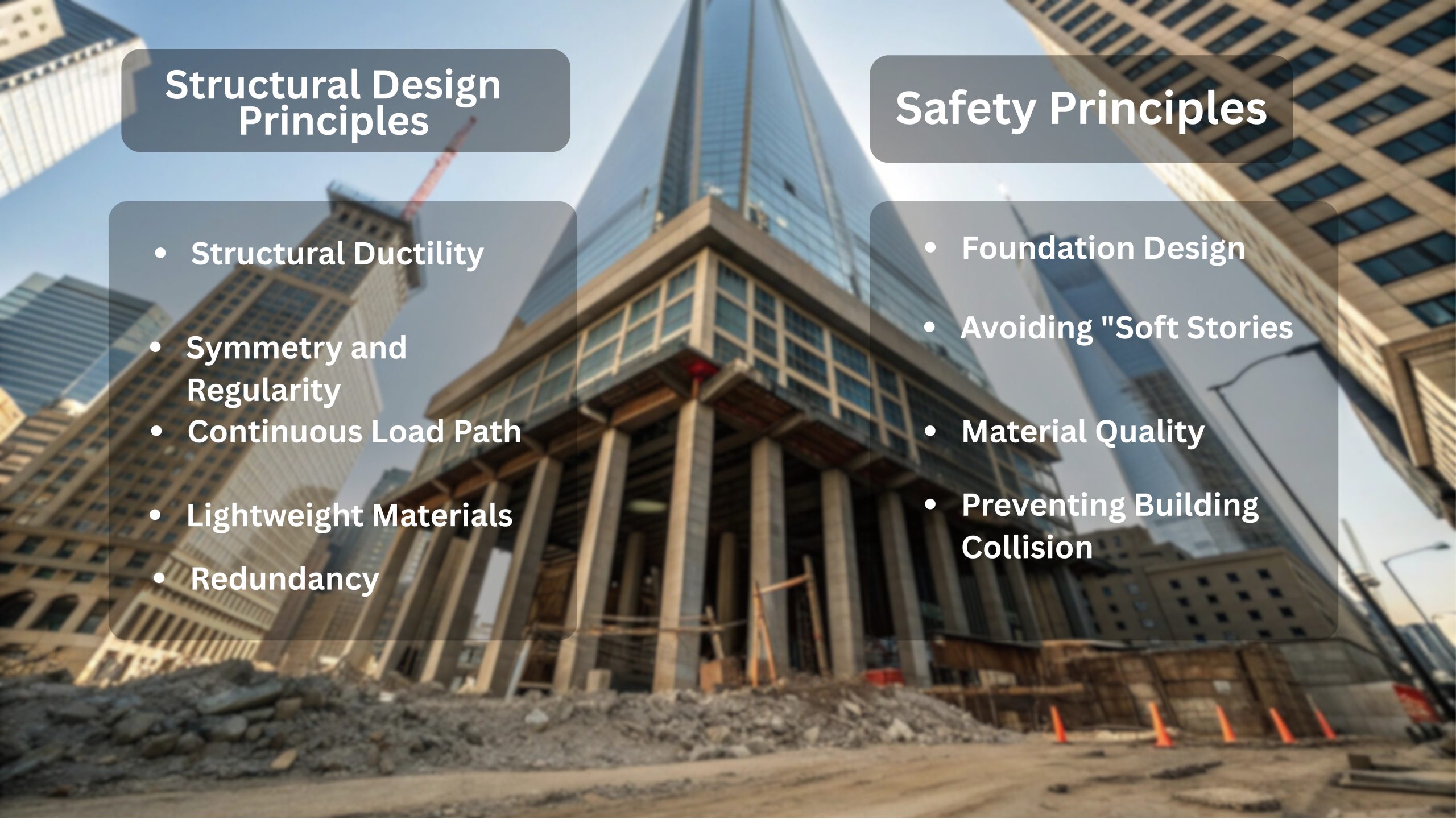
 In the last few decades, the rapid growth of urbanisation and vertical growth have made cities more vulnerable to natural catastrophes. In this regard, earthquakes are among the top dangerous and destructive dangers. The design of earthquake resistant buildings is no longer a luxury, It is essential to safeguard human lives and infrastructure investment and sustainable long-term. Modern structural engineering does not focus solely on strength, but also on flexibility, ductility and dissipation of energy.
The idea behind Earthquake Resistant Buildings is about understanding the forces of seismicity and ensuring that structures are able to absorb and redistribute the forces without collapse. Engineers or architects, planners, and construction professionals need to work together in the initial design phase to ensure safe and secure environments. With the advent of digital tools and workflows that are integrated, the method of seismic design has evolved to be more data-driven, scientific and based on performance.
The Growing Need for Earthquake Resistant Buildings in Modern Cities
Urban centres are growing rapidly with towers of high-rise, bridges, metro systems and mixed-use developments creating urban skylines. But, a lot of city centres in these are situated within seismic zones. The need for Earthquake Resistant Buildings is rising because of the increasing population density and land is becoming limited. A structural flaw in a city that is crowded can cause devastating loss of life and economic destruction.
Modern cities aren’t just expanding vertically, they are also becoming increasingly complex in technology. Hospitals, data centers, airports, smart buildings must function uninterrupted even in seismic events. The design of earthquake resistant buildings ensures not only structural integrity but also the continuity of operations. Engineers should assess seismic risks at the planning stage, taking into consideration aspects like site, soil conditions and the building’s use.
The main reasons to increase the focus on seismic safety
- Rapid urbanisation in seismic zones
- The rise of high-rises and complicated structures
- Human life security and public infrastructure
- Insurance and regulatory requirements that are strict
Engineers’ responsibilities are changing the role of engineers. With advances in digital modelling and analysis, the structural behavior under earthquake loads can be studied prior to construction beginning. This innovative approach is creating safer urban environments around the world.
How Earthquakes Affect Structures: Forces, Failures, and Risks
Earthquakes cause ground motions to cause dynamic forces to be created in structures. These forces work horizontally and vertically, causing the reversal of stress and vibrations in structural elements. The extent of damage varies on the size, distance from the epicentre, soil conditions and the structural design. Earthquake Resistant Buildings are designed to manage the forces with no sudden failure.
Seismic forces are primarily responsible for the lateral load, which is distinct from gravity loads. Structures that are sturdy in the face of vertical loads can fail when shaking is lateral in the event that they are not properly designed. Common structural problems include beam-column joint failures, soft-storey collapse and foundation movement. Understanding these patterns of failure can help engineers to improve Earthquake Resistant Buildings through better design and system selection.
Risks associated with earthquakes are significant:
- Structural collapse due to weak lateral resistance
- Effects of Torsional Forces in irregular buildings
- Soil liquefaction in loose sandy soils
- Progressive collapse as a result of inadequate path of load continuity
Designers should concentrate upon energy efficiency and the ability to control deformation. Instead of making structures too rigid Modern seismic design allows controlled flexibility. This reduces the chance of brittle-related failures and improves overall performance in safety.
Key Structural Design Principles for Earthquake Safety
Buildings designed for Earthquake Resistant Buildings are guided by the principles of balance rigidity, ductility, and stiffness. Ductility is crucial because it permits a structure to move without collapse. Structural elements should be planned meticulously to be able to withstand the repeatedly alternating loading and unloading in an earthquake.
One of the most important principles is the principle of symmetry in design. Uneven buildings exhibit torsional effects which result in increased stress concentrations. Engineers seek an even distribution of mass and uniform strength throughout the entire structure. A proper load path continuity will ensure that seismic forces can travel in a safe manner from the roof to the foundation.
Core design principles include:
- Adequate lateral load-resisting systems
- Strong column-weak beam concept
- The ductile detail of reinforcement
- Avoidance of soft-storey configurations
Digital tools like Revit Architecture assist engineers in visualizing structures and coordinates. The integration of structural and architectural models can reduce irregularities that could affect the seismic performance. The importance of technology in seismic planning is reflected in the game-changing role of BIM in which modelling and analysis tools improve the safety of people.
Design based on performance is also gaining popularity. Instead of following prescriptive regulations only, engineers examine the earthquake resistant buildings in different intensities and ensure safety in moderate and powerful earthquakes.
Seismic-Resistant Structural Systems and Building Materials
The selection of the right structural system is vital to build efficient Earthquake resistant Buildings. Frames made of reinforced concrete that resist momentary earthquakes wall, shear wall, braced frame and base isolation are frequently employed. Each of these systems offers a unique degree of stiffness, flexibility and energy dissipation capabilities.
Concrete shear walls that are reinforced offer superior stiffness along the lateral side and are commonly utilized in high-rise construction. Steel braced frames provide flexibility and lighter weight for structural structures which reduces the seismic force. Base isolation systems minimize transmitted ground motion by segregating the frame from the foundation by using specific bearings.
Comparison of Common Seismic Systems:
| Structural System | Key Feature | Advantage | Application |
| RC Moment Frame | Ductile beam-column joints | Energy absorption and flexibility | Commercial and residential buildings |
| Shear Wall System | Stiffness in the lateral area. | Reducing drift | Towers with high-rises |
| Steel Braced Frame | Light structure | Construction speed is faster | Industrial & commercial |
| Base Isolation | Reduction in seismic energy | It protects structural and non-structural components | Critical and critical facilities, hospitals |
The choice of materials also plays a significant role. High-strength cement, ductile reinforcement steel and engineered timber enhance the performance of. Professionals who take the MEP Design Course also learn the importance of having non-structural systems secure in a safe manner, as components like pipes and ducts can be damaged if they are not designed to withstand seismic movements.
The combination of structural and services systems guarantees that Earthquake Resistant Buildings maintain both structural integrity and functional performance during seismic events.
Foundation Design, Soil Behavior, and Seismic Building Codes
The effectiveness of earthquake resistant buildings is dependent in large part on foundation design and soil behavior. Even the strongest superstructures can fail if the foundation was not constructed to deal with earthquake-related ground movement. Soil type affects the amplifying of ground movement and settlement and liquefaction risk.
Soft soils are known to amplify seismic waves, which increases the demand for structural support. Liquefaction is when the soils are saturated and loose weaken during shaking, which can cause extreme foundation instability. Engineers conduct geotechnical research to determine the soil’s properties and develop foundation structures, such as pile foundations, raft foundations, or footings that are combined.
Important considerations in seismic foundation design:
- Site response and soil classification analysis
- Liquefaction potential assessment
- Anchorage that is correct and tie beams
- Building codes for seismic compliance
International and national codes for building provide guidelines to creating Earthquake resistant Buildings. These codes define load combinations, describing the requirements and performance goals. Engineers must adhere to these codes to ensure the safety of their customers and legal conformity.
Digital coordination tools that are covered in the BIM 360 training course allow teams working on projects to manage the compliance of code and documents effectively. Cloud-based platforms help improve collaboration between architectural, structural and geotechnical teams. decreasing design conflicts.
Retrofitting Strategies and the Future of Seismic Engineering
Many of the structures that are in existence were constructed prior to the time that modern seismic codes were established. Retrofitting is crucial to transform fragile structures into safer Earthquake resistant buildings. Methods include installing steel bracing, shear walls the column, jacketing of columns, and bases isolation retrofits.
Retrofitting requires an in-depth analysis of the structural structure and evaluation of performance. Engineers analyze the capacity to load, material condition and the structure before choosing the best strengthening method. The objective is to improve the ductility and strength of the lateral side without overly demolition.
Common retrofitting strategies:
- Steel jacketing of columns
- Shear walls are added to the shear wall.
- Installation of base isolation units
- Polymer wrap with fibre reinforcement
A new era for Earthquake Resistant Buildings lies in innovative materials, performance-based design and sophisticated simulation tools. Monitoring systems that are real-time and based on sensors will monitor the performance of buildings in earthquakes. Predictive models are influencing the next generation of seismic engineering.
As outlined in the Game-Changing role of BIM Digital integration allows engineers to model seismic behavior prior to construction and increase the resilience of buildings. Collaboration across disciplines leads to safe and sustainable urban development.
Conclusion
Designing earthquake resistant buildings can be described as a cross-disciplinary process which combines structural engineering concepts and geotechnical expertise, material science and digital coordination. From understanding the seismic force to choosing appropriate foundation and structural solutions, every stage plays an important function in ensuring safety.
Modern tools like Revit Architecture, cloud collaboration platforms that are covered in the BIM 360 training course, and the interdisciplinary approach to learning that is offered by taking the MEP Design Course strengthen the connection between design and implementation. Through the application of solid design principles and modern technology, engineers are able to create sturdy structures that are able to protect people and investment. Earthquake Resistant Buildings represent an investment in safety in the workplace, and innovative urban development. In the years to come, as cities expand and expand, seismic resilience will be the foundation of sustainable building methods.
Related quotes
- “Earthquake resistant buildings are not about fighting nature, but about designing structures that move with it and survive.”
- “Strength alone does not ensure safety in seismic design; flexibility, ductility, and energy dissipation are what truly protect lives.”
- “In rapidly growing cities, seismic resilience is no longer optional. It is a fundamental responsibility.”
- “A well-designed building does not collapse under pressure. It absorbs, redistributes, and adapts to seismic forces.”
- “The key to earthquake safety lies in understanding lateral forces and ensuring a continuous load path from roof to foundation.”
- “Symmetry, ductility, and balanced stiffness form the backbone of effective seismic structural design.”
- “Modern seismic engineering combines structural science, geotechnical insight, and digital modeling to create safer urban environments.”
- “The right structural system, whether shear walls, moment frames, or base isolation, can mean the difference between damage and disaster.”
- “Retrofitting older buildings is an investment in resilience, transforming vulnerable structures into life-saving assets.”
- “Earthquake resistant buildings represent more than engineering achievement. They reflect a commitment to human safety, sustainability, and responsible urban development.”