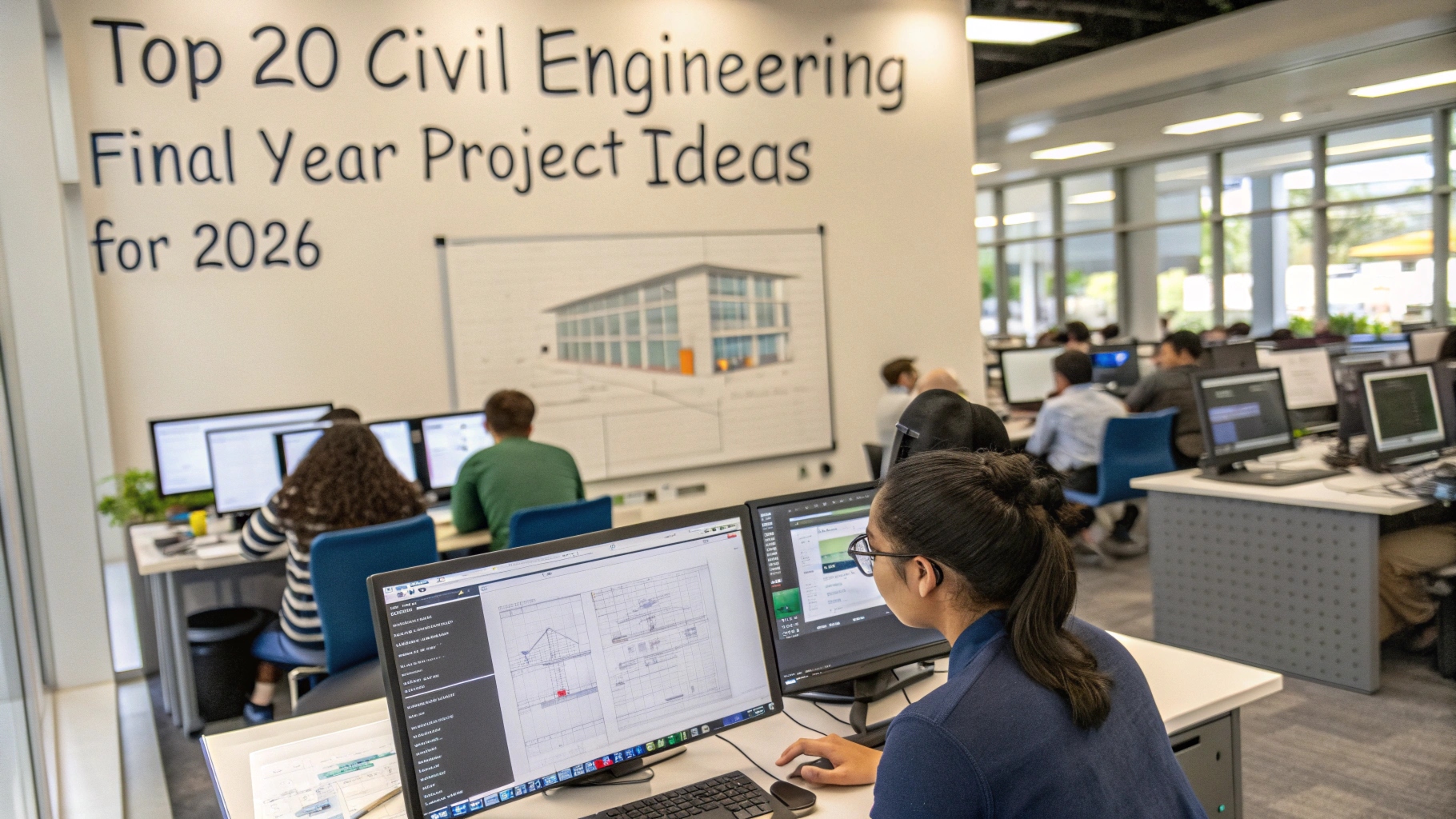
 Projects in the final years are the most important stage in each Civil Engineering student’s academic journey. They’re not only about getting marks, but using four years of technical expertise to solve real-world issues. The expectations of the 2026 project are shifting. Digital construction, sustainability, smart cities, smart cities, and climate resilience are now important themes in Civil Engineering education and practice.
Must read: Professional BIM Course for Civil Engineers: Redefine Your Career
Below are 20 hot and practical Civil Engineering final year project ideas for 2026:
- Intelligent Traffic Management System Using AI
- Sustainable Concrete made from Industrial Waste Materials
- Earthquake-Resistant Design Analysis for Buildings
- Green Building Design with Energy Modelling
- The Rainwater Harvesting Optimization Strategy for Urban Areas
- Plastic Refuse in Road Construction
- Monitoring the health of structures using sensors
- Flood Risk Assessment and Drainage Plan
- Smart Irrigation System for Agriculture
- Geopolymer Concrete is a geopolymer concrete
- 3D-printed Building Components
- Bridge Load Analysis Utilizing BIM Tool
- Construction Waste Management Strategies
- Solar-powered residential building design for homes
- Metro Rail Alignment and Planning Study
- Soil Stabilization Using Eco-Friendly Methods
- Smart Parking Solutions for Urban Cities
- Retrofitting Techniques for old structures
- Low-cost Affordable Housing Design to be used in Rural Areas
- Digital Twin Application in Infrastructure Projects
These are the ideas that reflect the expanding integration of sustainability and technology in Civil Engineering practice.
What Civil Engineering Projects Teach You Beyond the Classroom
The final year’s projects for Civil Engineering go far beyond the text books and classroom lectures. They help students face real-world constraints like budget limitations and site issues, and availability of materials and managing time. While the theory provides information and projects that test your abilities, use them within real-world situations. Students work in live or simulation-based projects They develop skills for problem solving and teamwork and confidence. For instance, using BIM software for civil engineers lets students visualize structures, spot conflicts, and recognize the relationship between structural and architectural systems. This hands-on training will prepare them for future work.
Essential Skills Learned Through Projects
- Design Thinking and analysis of technical aspects
- Data interpretation and site planning
- Skills in communication and presentation
- Digital modelling and modeling with software
- Safety awareness and risk assessment
Participating in the Civil Engineering projects also improves the capacity to make decisions. Students are taught to justify their choices in design by using the calculations and standards and sustainability factors. This helps them develop professional confidence and maturity prior to going into the workforce.
Mini Projects vs Major Projects: What Works Best in 2026
Within Civil Engineering, both mini projects and major ones possess importance. But their goals and effects differ. Mini projects tend to be brief-term and focus on a specific idea, such as soil testing analyses of traffic, and smaller task-related tasks for structural design. Major projects are, however, a thorough analysis, research, and analysis that spans many months.
In 2026, big projects that integrate sustainability with digital tools are getting more recognition. Employers are looking for candidates who are able to integrate design ideas using software tools and real-world data.
Mini Projects – How to Select They are
- Time-limited availability
- Learning with focus
- An introduction to research
Major Projects What makes them stand out?
- Wider problem-solving horizon
- Chance to make use of the latest tools
- Better portfolio value
- Stronger impact during placements
Students who are pursuing an interdisciplinary approach for example, like the MEP Design Course , may integrate structural and service design into a single final project. This provides depth and an understanding of cross-disciplinary issues which is highly sought-after in current Civil Engineering roles.
Case Studies of Successful Student Projects
Reviewing the success of Civil Engineering projects can help students plan and execute better. For instance, a group of students created the flood prediction model by utilizing GIS map data and rain gauges. The project was later endorsed by a local municipality to assist in making drainage improvements.
Another team developed an affordable housing model made of recycled materials and energy efficient design methods. Through incorporating BIM training for architects into their model-making process they came up with an integrated digital model that enhanced accuracy and the quality of the presentation.
What made these projects successful?
- Clear problem statement
- Relevance in real-world situations
- Strong data analysis
- Proper documentation
- Digital tools that are effective in their use
One project for structural analysis used BIM software for civil engineers to model the load behavior in a multi-storey structure. Digital visualization helped the examiners easily comprehend the design concept. These case studies show how contemporary Civil Engineering projects are evolving from simple reports to technologically-driven solutions.
MUST READ: The 5 Best BIM Courses for Civil Engineers in Delhi (2024)
Tips to Present and Document Your Project Like a Pro
Even a technically solid Civil Engineering projects can lose points if it is not properly presented. Presentation and documentation are just as crucial as the technical content. In 2026, the examiners will demand high-quality reports with clear graphics and well-organized explanations.
How to Format Your Project Report
- Abstract and introduction
- Review of literature
- Methodology
- Results and analysis
- Conclusion and recommendations
Include graphs, charts designs calculations, charts, and 3D graphics wherever possible. If your project involves modeling images from BIM software for civil engineers can help strengthen your documentation.
Tips for a Successful Presentation
- Keep slides simple and concise.
- Use diagrams in place of text.
- Make calculations with confidence
- Be prepared to answer any technical questions
Students studying Civil Engineering often underestimate the importance of communicating. Practice your explanation prior to the final viva will significantly enhance the quality of your performance.
Common Mistakes to Avoid When Doing Final Year Civil Projects
A lot of Civil Engineering students make avoidable mistakes in finishing their projects. A common mistake is choosing an area that is too broad or unattainable within the timeframe available. Another mistake is relying too heavily on theories without any practical proof.
Many mistakes
- Poor time management
- Replicating previous reports for projects
- Weak data collection
- Doing nothing to protect yourself and disregarding codes of conduct
- Simulation or testing that is not adequate
Students are also unable to keep up-to-date with the latest developments regarding Civil Engineering. Modern projects require modern tools, sustainability and intelligent solutions. Don’t choose topics that are old-fashioned and do not have the latest technology.
Another mistake is ignoring inter-disciplinary coordination. In particular knowing the MEP and structural integration with the experience of the MEP Design Course can enhance the quality of a project. Projects that show the coordination of systems are highlighted when evaluating.
Conclusion
Final year projects signify the transition into a professional from Civil Engineering. The right choice of topic and utilizing the latest tools and effectively presenting your work can greatly impact your career direction.
In 2026, innovative Civil Engineering projects will focus on sustainability, digital modeling and problem-solving in the real world. Utilizing tools such as BIM software for civil engineers, developing multidisciplinary skills using the MEP Design Course, and mastering coordination methods that are similar as BIM training for architects will aid in the creation of a project that is distinctive.
Remember that your final year project is much more than just a submission. It’s your debut professional portfolio of Civil Engineering, so plan well and present it with confidence.
Related FAQ’s
1. What are the best final year project ideas in Civil Engineering for 2026?
Trending ideas include sustainable construction materials, smart traffic systems, earthquake-resistant structures, green building design, and BIM-based infrastructure modelling.
2. How do I choose a good Civil Engineering final year project?
Choose a topic that is practical, relevant to current industry trends, manageable within your timeline, and aligned with your career goals in Civil Engineering.
3. Are mini projects better than major projects in Civil Engineering?
Mini projects are good for concept clarity, but major projects offer deeper research, better portfolio value, and stronger placement opportunities.
4. How important is BIM in Civil Engineering final year projects?
BIM is highly important as it improves design accuracy, coordination, and visualisation. Using BIM software for civil engineers adds professional value to your project.
5. Can I combine structural and MEP topics in my Civil Engineering projects?
Yes, integrating structural and services design, especially with knowledge from an MEP Design Course, makes your project more practical and industry-oriented.
6. What are common mistakes in Civil Engineering final year projects?
Common mistakes include poor time management, copying old reports, weak data analysis, and ignoring modern tools or sustainability aspects.
7. How can I make my Civil Engineering projects stand out during viva?
Prepare clear documentation, use visuals and models, explain calculations confidently, and demonstrate practical understanding of your topic.
8. Does a final year project affect placements in Civil Engineering?
Yes, a strong and innovative project can improve your chances of placement, as it reflects your technical skills and practical knowledge.
Related quotes
“Engineering is about solving real problems, not just passing exams.”
— Henry Petroski
“The best structures are built where creativity meets calculation.”
— Fazlur Rahman Khan
“Sustainability is no longer optional in engineering; it is responsibility.”
— Norman Foster
“Technology transforms ideas into structures that shape our future.”
— Buckminster Fuller
“A great project begins with a clear problem and a practical solution.”
— John Ruskin
“Digital tools help engineers see what was once invisible.”
— Charles Eastman (BIM Pioneer)
“Innovation in construction comes from those who question traditional methods.”
— Elon Musk
“Engineers build the world, but curiosity builds the engineer.”
— Neil deGrasse Tyson
“Good design is not only strong and safe, but also sustainable.”
— Norman Foster
“Every great engineering career starts with one meaningful project.”
— Henry Petroski