How 3D Printing is Revolutionizing MEP Component Fabrication
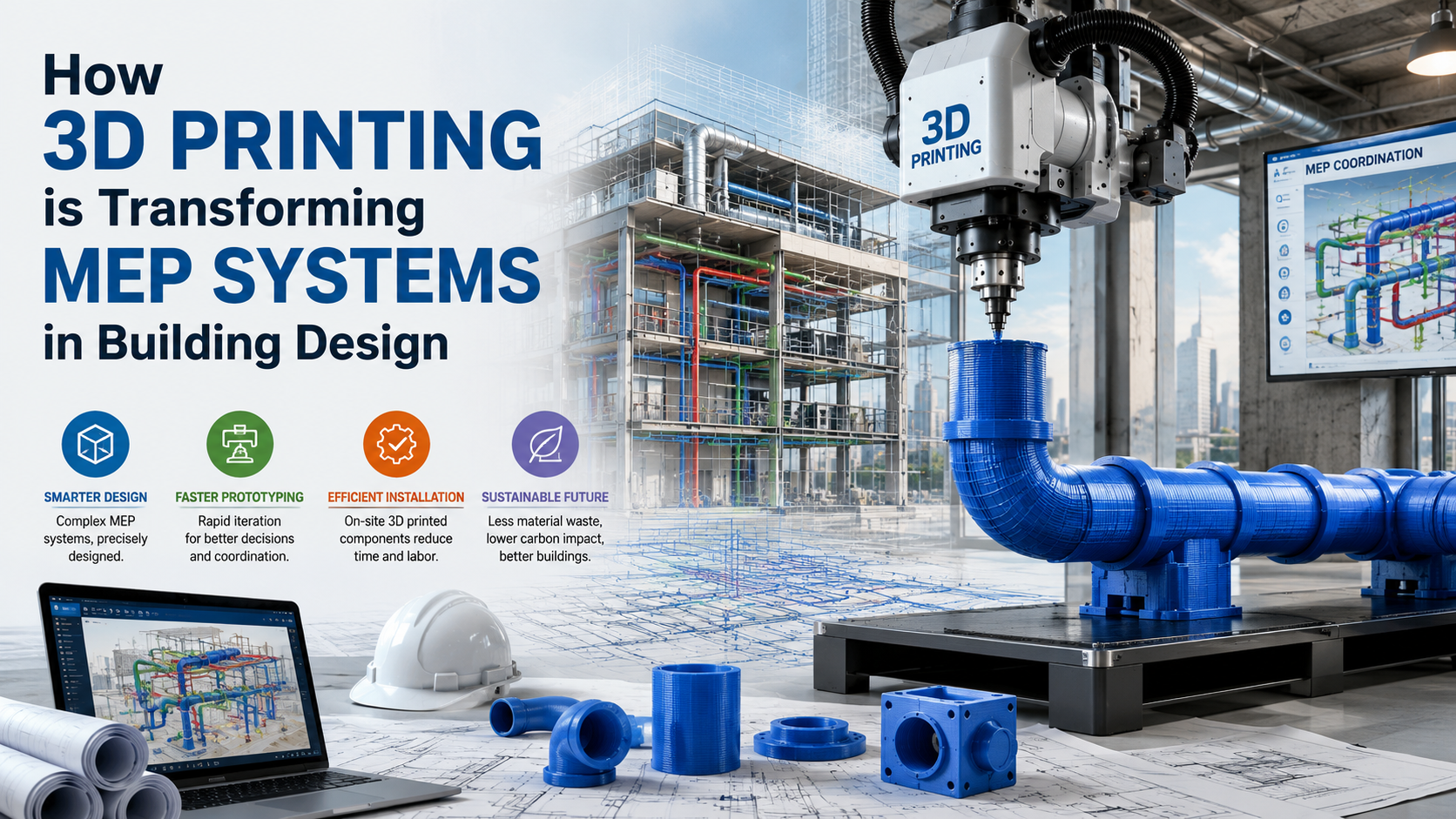
Construction is going through an important shift in the last few years, and 3D Printing is transforming MEP Systems by changing the way parts are created and manufactured. Traditionally MEP (Mechanical Electrical, Plumbing,) components were fabricated with standard molds and manual processes. This typically limited customization and created the amount of waste. By using 3-D printing technology, designers are able to produce highly precise and custom-designed components by using digital models. This change not only decreases production times but also guarantees higher accuracy for complex designs. Professionals who are taking bim courses are now incorporating these technologies to increase the coordination between design and fabrication.
Another benefit is the ability to create prototypes quickly. Engineers can experiment and improve MEP components prior to full-scale production which reduces the chance of errors in installation. This is in line with the latest workflows, such as Civil 3D Essentials, where digital design is matched with real-world implementation. Furthermore, professionals who specialize in bim in civil engineering are increasingly utilizing 3D printing to build effective and flexible systems. In the end, 3D Printing is Transforming MEP Systems through the use of faster, smarter and more sustainable manufacturing processes.
Advantages of key fabrication techniques:
- High-precision and customization
- Reduction of material waste
- Production and prototyping speed is increased.
- Improved design flexibility
Benefits of 3D Printing in MEP Systems: Cost, Speed, and Sustainability
One of the main reasons 3D Printing is Transforming MEP Systems is the ability to lower costs while increasing efficiency. Traditional manufacturing involves several steps, like cutting, molding and assembly that can be expensive and lengthy. Contrarily, 3D printing simplifies the process of manufacturing components by completing only one step. This not only decreases the cost of labor, but also decreases the amount of material used. Professionals trained in bim courses typically employ these strategies to improve project budgets and timeframes.
Speed is a further advantage. Through 3D printing, parts are produced at any time, avoiding any delays that are caused by chain of supply. This is particularly beneficial for large-scale construction projects, where the time factor is crucial. Sustainability is another major benefit, as 3D printing reduces waste and encourages the utilization of environmentally friendly materials. Engineers who work in bim in civil engineering as well as those who are undergoing bim management training are benefiting from these advantages to design more sustainable and eco-friendly designs. Integrating Civil 3D Essentials improves the workflow, making 3D printing a revolution in MEP Systems a key driver of technological innovation.
| Benefit Type | Description | Impact on Projects |
| Cost Efficiency | Reduces material waste and minimizes labor by eliminating multiple steps | Lower overall project cost |
| Speed | Enables faster production and on-demand fabrication of MEP components | Shorter project timelines |
| Sustainability | Uses eco-friendly materials and reduces construction waste | Environmentally responsible construction |
| Accuracy | Produces highly precise and customized components | Fewer errors and rework |
| Flexibility | Allows easy design modifications and complex geometries | Better design adaptability |
The benefits of core
- Lower labor and production costs
- Speedier project completion
- Impact on the environment reduced
- Increased efficiency of resource use
Applications of 3D Printing in HVAC, Plumbing, and Electrical Systems
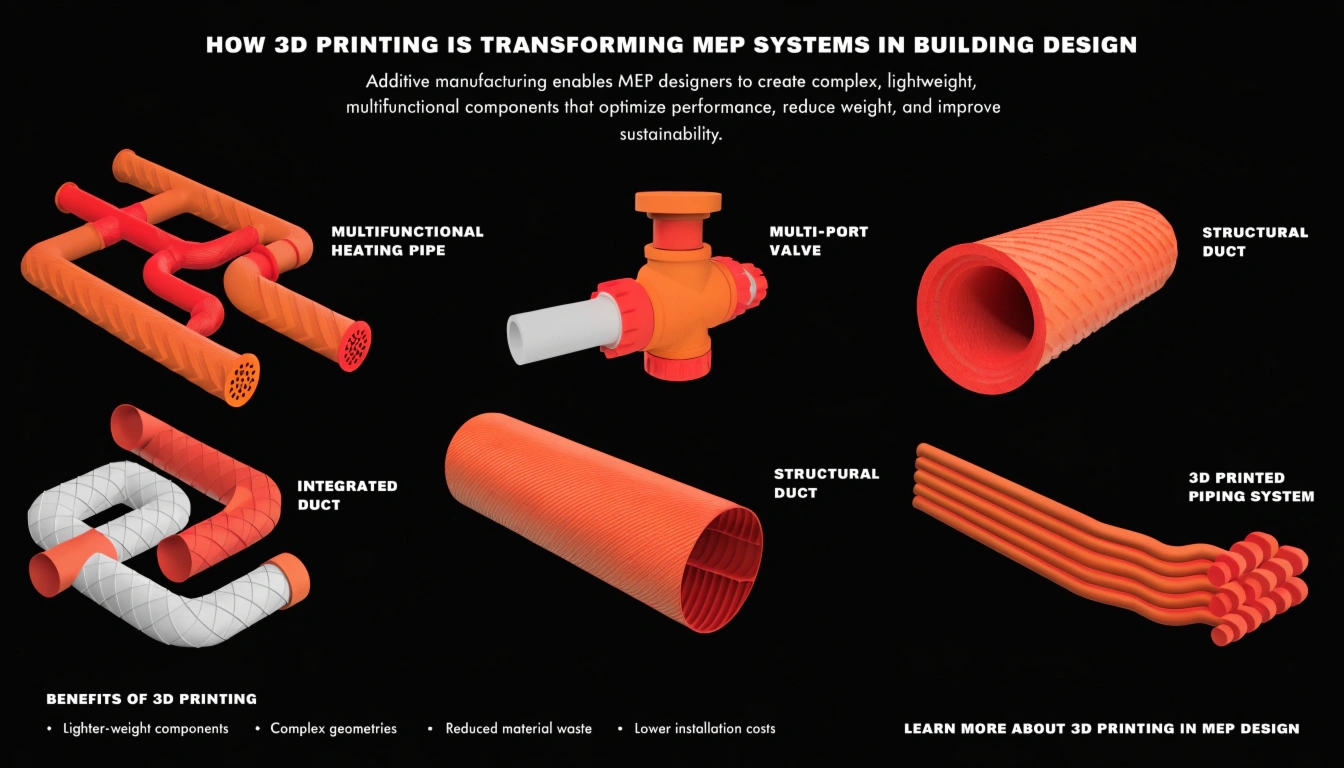
Applications of 3D printing are transforming MEP Systems are becoming increasingly apparent across HVAC plumbing, electrical, and systems. In HVAC systems 3D printing permits the design of intricate airflow geometries to improve efficiency. Custom designs are hard to make using conventional methods, but can be created by using additive manufacturing. Professionals in bim courses frequently employ these sophisticated designs to improve the performance of their systems.
In the electrical and plumbing sectors, 3D printing enables the creation of custom fittings as well as enclosures, connectors and fittings. This eliminates the requirement for standard components, and makes for more efficient layouts of systems. Engineers who work in bim in civil engineering, as well as those who are undergoing bim management training utilize these tools to enhance the results of projects. Integrating Civil 3D Essentials assures that these plans are precisely implemented. In the end, 3D Printing is Transforming MEP Systems by providing new solutions that span multiple disciplines.
| System Type | 3D Printing Application | Key Benefit | Impact on Performance |
| HVAC | Custom duct geometries and airflow components | Improved airflow efficiency | Better energy performance |
| HVAC | Lightweight ventilation parts | Reduced material usage | Easier installation |
| Plumbing | Customized pipe fittings and connectors | Flexible design and precision | Reduced leakage and errors |
| Plumbing | Complex piping layouts | Fewer joints and connections | Improved durability |
| Electrical | Enclosures and cable management systems | Tailored component design | Enhanced safety and organization |
| Electrical | Smart system housings | Integration with modern tech | Better system efficiency |
The most important applications are:
- HVAC ducts and airflow parts
- Custom plumbing fittings
- Conduits and electrical enclosures
- Modules MEP integrated
Integration of 3D Printing and BIM MEP Design. MEP Design
A combination of BIM as well as 3D printing represents one the most important developments in the field of construction technology of today. 3D Printing is Transforming MEP Systems by creating seamless integration between physical and digital design. BIM models provide precise details on MEP systems that could be directly utilized to print 3D models. This helps reduce errors and ensures that the components are perfectly positioned in the process of installation. Professionals taking bim courses are taught to make use of this integration effectively.
This synergy improves collaboration between project teams. Engineers as well as architects and contractors are able to work with a shared BIM model, which ensures that all parts are in alignment prior to the production. Experts who specialize in Bim in civil engineering as well as those who undergo bim management training are essential to managing the workflows. The idea behind Civil 3D Essentials further supports this integration by reducing the complexity of designs. In the end, 3D Printing is Transforming MEP Systems by bridging the gap between design and construction.
Integration benefits:
- Production that is accurate and error-free
- Team collaboration improved
- Faster project execution
- Better design visualization
Materials Used in 3D Printing for MEP Systems
The effectiveness of 3D Printing transforms MEP Systems depends largely on the materials utilized during the process. The most common materials are plastics, composite materials, and metals with each having distinct advantages. Plastics are extensively used to make lightweight components, whereas metals are the best choice for high-strength components. Engineers who have completed bim courses usually select the materials based on the project’s requirements and performance specifications.
Modern materials, such as thermally resistant polymers and the conductive composites are employed for MEP systems. These materials increase the performance and durability of the components, making them ideal for harsh environments. Professionals working for Bim in civil engineering as well as those who are undergoing bim management training make use of these materials to come up with new solutions. Integration of Civil 3D Essentials assures that the material choice is in line with the design specifications.
Common Materials Table
| Material Type | Application |
| Plastics | Ducts, fittings |
| Metals | Structural components |
| Composites | Parts with high-performance |
| Polymers | Applications that are heat-resistant |
The Future of 3D-Printed MEP Systems in Smart and Modular Buildings
In the future, 3D Printing is Transforming MEP Systems will play a vital role in the creation of modular and smart structures. These buildings are built using prefabricated parts which can be assembled quickly at the site. 3D printing allows the manufacturing of these parts with precision, which reduces the time required to construct and also the cost. Professionals who have completed bim courses are already getting ready for this change by acquiring advanced fabrication and design techniques.
The smart buildings will also need systems that are integrated and can adapt to changes in the needs of customers. 3D printing permits the development of customizable and flexible MEP components, which makes it much easier to update and maintain systems. Engineers who are working in bim in civil engineering and those in bim management training are at the leading edge of the advancement. With the help by Civil 3D Essentials, these innovations are influencing what the construction industry will look like in future. As technology continues to advance, 3D Printing is transforming MEP Systems will remain a major driver for advancement.
Future trends:
- The growth of modular construction
- Integration of smart technologies with smart technology
- The increased use of sustainable materials
- Automation of the manufacturing process
Conclusion
Impact of 3D printing on transforming MEP Systems is evident throughout the entire process of development and building construction. From design to construction it is enhancing efficiency, decreasing costs, and providing new solutions. Professionals who are investing in their education through bim courses and gain knowledge in bim in civil engineering will be able to profit from these developments.
As the building industry strives to create greener, more green buildings, the importance of 3D printing will continue to increase. With the help of bim management training and concepts such as Civil 3D Essentials, engineers and designers can design more flexible and efficient systems. Through the adoption of these technologies construction companies can reach greater levels of efficiency and innovation.
Frequently Asked Questions (FAQs)
- What is 3D printing in construction?
3D printing in construction is a process where buildings or components are created layer by layer using automated machines based on digital designs. It reduces manual work and increases precision. - How does 3D printing improve construction efficiency?
It speeds up project timelines, reduces material waste, and minimizes human errors through automation, making construction faster and more cost-effective. - What materials are commonly used in construction 3D printing?
Common materials include special concrete mixtures, geopolymers, and recyclable composites designed for strength, durability, and sustainability. - Is 3D-printed construction safe and durable?
Yes, when properly designed and tested, 3D-printed structures can meet safety standards. However, long-term performance data is still being studied. - How does BIM support 3D printing in construction?
BIM provides accurate digital models that guide the printing process, ensuring precision, clash detection, and better coordination throughout the project lifecycle. - What role does AI play in the construction of 3D printing?
AI helps in monitoring print quality, predicting equipment issues, optimizing material usage, and improving overall accuracy during the construction process. - What are the main advantages of using 3D printing in construction?
The key advantages include faster construction, reduced costs, design flexibility, improved safety, and enhanced sustainability. - What are the challenges of 3D printing in construction?
Major challenges include high initial costs, lack of standardized regulations, limited material options, and the need for skilled professionals. - Where is 3D printing currently used in construction projects?
It is used in building houses, offices, infrastructure components, and even disaster-relief shelters across various parts of the world. - What is the future of 3D printing in construction?
The future includes more automation, integration with robotics and AI, use of eco-friendly materials, and wider adoption in residential and commercial projects. - Can 3D printing be used for large-scale infrastructure projects?
Yes, it is increasingly being used for bridges, pavements, and structural components, though large-scale adoption is still developing. - Is 3D printing suitable for affordable housing?
Yes, it is highly suitable for affordable housing due to its ability to reduce costs and construction time, especially in disaster-prone or low-income regions.