AEC professionals must select the right digital tool in order to navigate the construction and design industry, which is rapidly changing. The right software tools are essential for completing projects efficiently, particularly in the face of increasing client expectations and complex projects. Revit, Tekla, and Rhino have been the most commonly discussed tools. Understanding the differences between these platforms helps AEC professionals make better career and project choices.
Why tool selection is important for AEC professionals
Software is more than just a tool for building models. It affects coordination, accuracy, and cost control. Architects and engineers rely on tools that are appropriate to their role. Bim for Architects and BIM for Project Managers training programs begin with a thorough understanding of the tools, workflows, and techniques.
By choosing the right platform, AEC professionals will be able to improve their productivity, reduce mistakes, and boost confidence in project delivery. Revit, Tekla, and Rhino each address different needs within the AEC ecosystem.
Revit as BIM-Centred Software
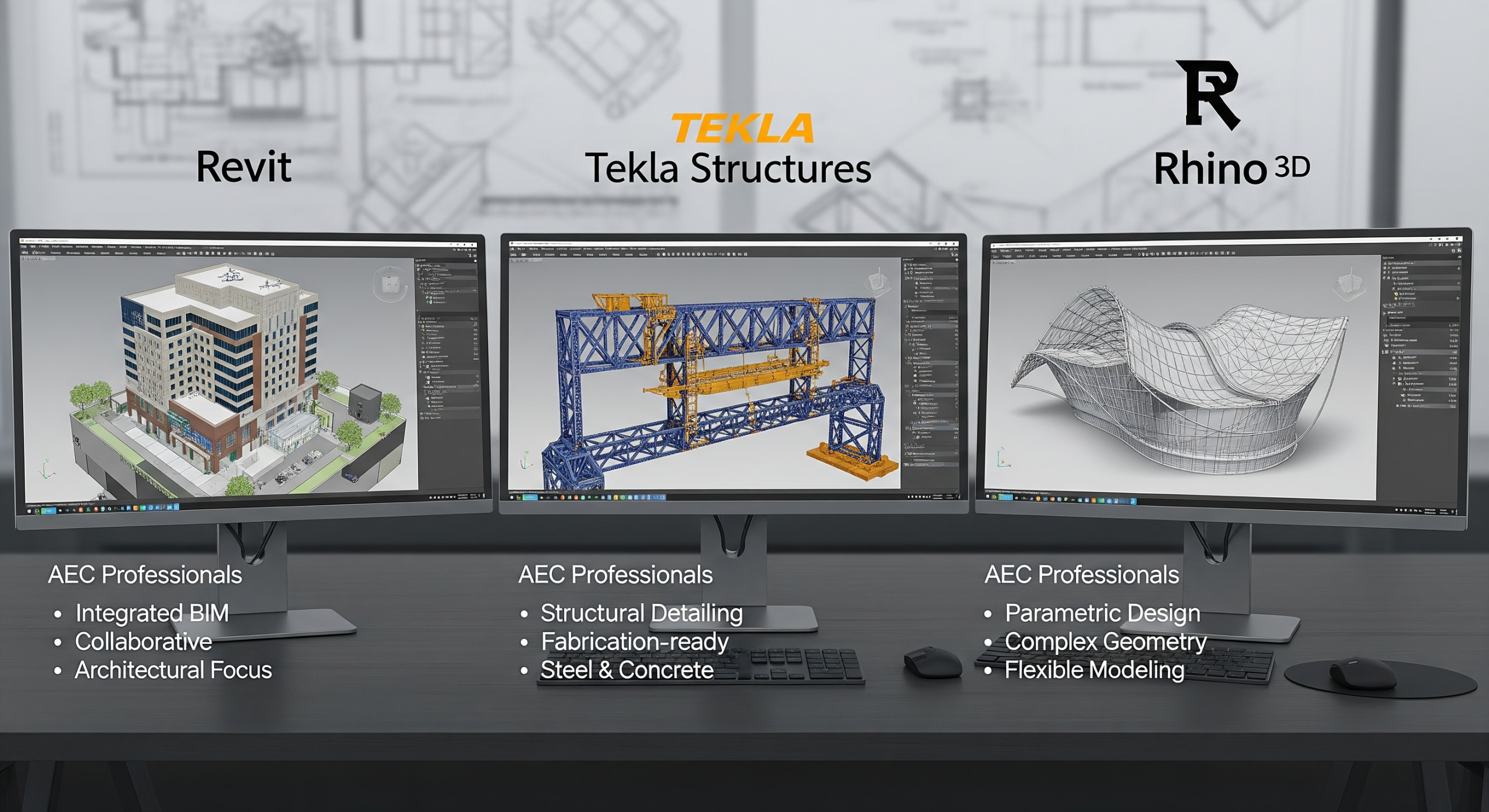
AEC professionals often encounter Revit as their first BIM software. The software is based on the idea of Building Information Modelling, where data and geometry work together. Revit is a powerful tool that allows teams to create intelligent, coordinated models.
Revit is a powerful tool for those who are learning BIM for architects. It supports design, documentation, and coordination within a single environment. The changes made in one view are reflected in all views, saving you time and avoiding inconsistent results. Revit is a valuable tool for AEC professionals who work on large projects.
BIM for project managers. Managers can maintain a structured workflow, track design changes, and coordinate across disciplines. Some AEC professionals believe that Revit is restrictive in the early stages of conceptual design because it’s rule-based.
Tekla for Structural accuracy and Detailing
Tekla’s strength in structural modeling and detailing is well-known among AEC professionals. Tekla is used extensively in projects that require high accuracy. This includes steel and concrete structures. Tekla models can be used directly in fabrication, demonstrating their precision.
Tekla is a powerful tool for structural AEC professionals who need to control connections, reinforcements, and material quantities. Tekla, while not often associated with BIM for architects, is highly respected by engineers who need constructible models.
Tekla can have a steeper learning curve, but it is worth the effort for AEC professionals who work on industrial plants or bridges. The focus is on real-world constructability rather than visual presentation, as is expected in advanced BIM environments.
Rhino Conceptual and Free Form Design
Rhino is a totally different experience from Revit or Tekla for AEC professionals. It emphasizes flexibility, creativity, and complex geometry. Rhino is particularly popular for early design stages, when exploring shapes and forms is more important than documentation.
Rhino is a visual scripting tool that supports parametric modelling and creative thinking for learners who are interested in BIM for architects. It allows architects the freedom to experiment and push boundaries. Rhino is used by many AEC professionals to create concepts, which are then integrated into BIM platforms.
Rhino, however, is not a complete BIM tool. It doesn’t manage project data like Revit, so AEC professionals combine it with other programs. Rhino works best as a design partner, rather than a stand-alone solution for construction documentation.
Compare the practical use of real projects
AEC professionals rarely use just one tool. Revit is used most often for coordination and documentation. Tekla is typically used for structural detailing. Rhino is usually used for concept development. The decision depends on the project stage and role.
Revit is often the platform of choice for BIM for project managers because it provides control over information and coordination. Tekla is a tool that helps teams focus on execution, while Rhino boosts creativity. Understanding the interaction of these tools is essential for AEC professionals.
Projects that involve innovative design and complex engineering can inspire professionals with ideas similar to those found in Electrical Project Ideas. This is where creativity and technical power meet. These projects require a balanced approach to tools, rather than relying on one platform.
Career Impact AEC Professionals
AEC professionals can benefit from learning the right tools to help them advance their careers. Knowledge of Revit opens the door to BIM multidisciplinary roles. Tekla knowledge positions professionals well in organizations that focus on structural and construction design. Rhino expertise attracts design-driven studios and firms.
Training paths focused on BIM for architects can help designers go beyond drawing to intelligent modeling. BIM is also a great way to prepare professionals for leading teams, managing data, and ensuring smooth project delivery. For AEC professionals, tool and workflow knowledge creates career stability.
Learn how to be a modern AEC professional with our learning strategy.
Instead of comparing the tools, AEC professionals should concentrate on how and when they can be used. Revit provides a solid BIM foundation. Tekla enhances structural depth. Rhino increases creative capabilities. Together, these tools form a powerful set of skills.
AEC professionals can gain practical experience through industry-focused learning environments, rather than simply theoretical knowledge. This ensures skills are relevant and can be applied to real projects both in India and abroad.
Conclusion
For AEC professionals, the comparison of Revit, Tekla, and Rhino does not involve choosing one tool over another but rather understanding the role that each tool plays throughout the project lifecycle. Revit is a BIM tool that supports BIM workflows, Tekla provides unmatched structural accuracy, and Rhino enables creative design exploration. These tools, when used in conjunction with BIM for architects or bim for project managers, help AEC professionals to deliver better projects. They also enable them to grow in their careers and remain competitive in a rapidly evolving industry.