In the current era of infrastructure and construction advancement, Building Information Modeling (BIM) has revolutionized the way architects, engineers, and construction professionals design, build, and manage projects. Many tools can be integrated effortlessly into BIM workflows. Civil 3D stands out as a powerful tool for design and engineering teams and civil engineers. Understanding how Civil 3D enhances BIM workflows is essential for professionals pursuing BIM-related education or online civil engineering courses.
Understanding Civil 3D and Its Role in BIM
Civil 3D is Autodesk’s design and documentation software specifically designed for civil engineering projects. It focuses on providing sophisticated 3D models of infrastructure projects such as roads, land development, and drainage systems. By integrating design and documentation into BIM workflows, Civil 3D enables teams to see, analyze, and improve projects before construction.
BIM, on the contrary, is a process that integrates design, planning, construction, and operations in a digitally collaborative environment. The use of Civil 3D within BIM workflows assures that data is uniform, reliable, precise, and available throughout the entire lifecycle of a project. Engineers and architects can coordinate efficiently, reducing mistakes and rework.
Key Benefits of Civil 3D in BIM Workflows
1. Streamlined Collaboration Between Teams
Civil 3D can be used to share models and manage data, enabling the civil engineering team, architects, and project managers to collaborate in real time. Design changes are automatically applied across the model, reducing conflicts and miscommunication. Professionals who are enrolled in BIM for Architects or civil engineering courses that master this feature improve team efficiency and coordination.
2. Improved Design Accuracy
Civil 3D employs dynamic modeling. This ensures that any change to one element of the design alters the other components. For example, changing the road alignment will automatically update the profiling, grading, and design of a corridor. This ensures the accuracy of the design documentation, reduces human error, and also saves precious time during design.
3. Enhanced Visualization and Analysis
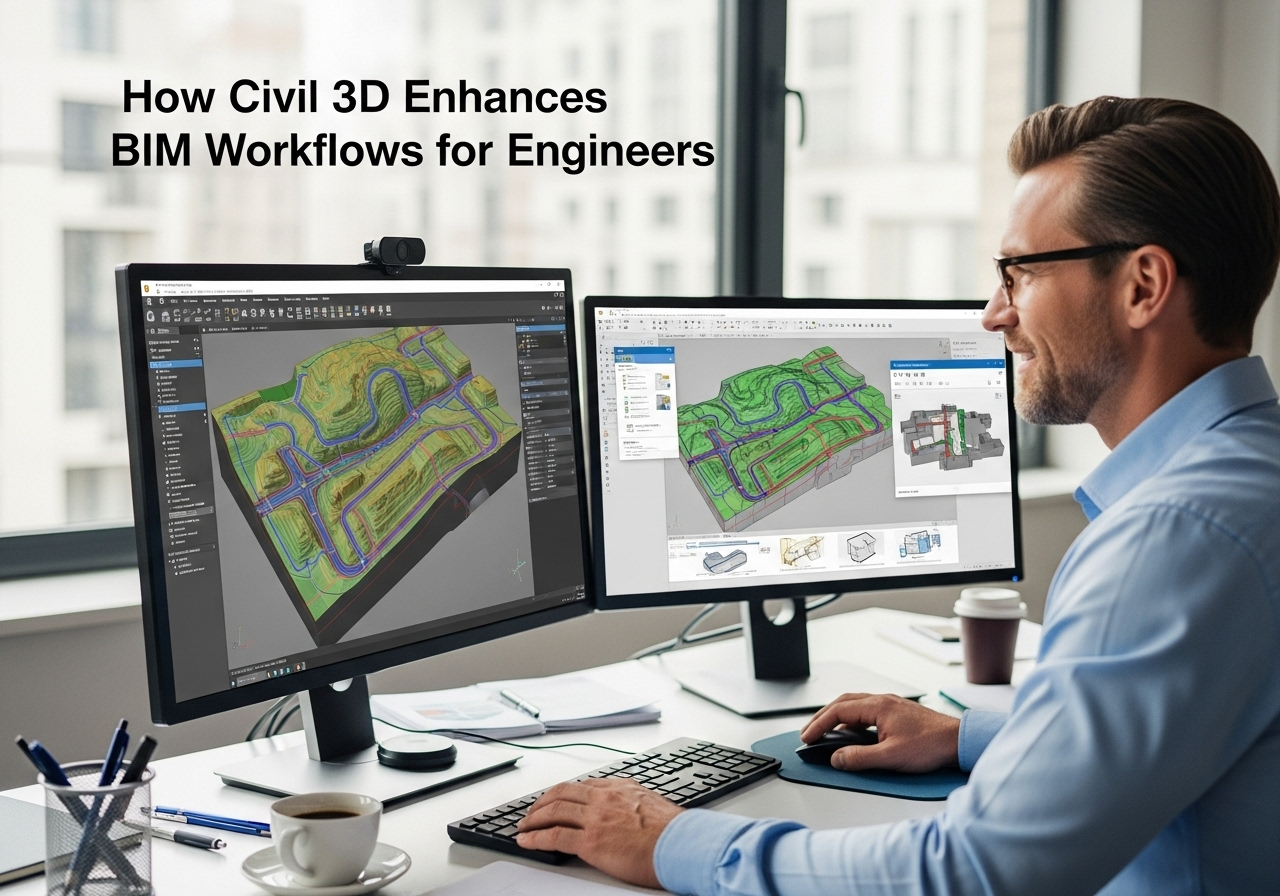
Civil 3D lets engineers develop 3D visualisations for infrastructure projects. The models can be integrated into other BIM software to provide precise simulations of terrain, drainage systems, and structural structures. Visualization aids engineers in identifying possible issues earlier and assessing various design scenarios. Civil engineering professionals who take online classes gain experience with these tools and prepare for real-world projects.
4. Efficient Data Management
BIM is heavily dependent on structured data to schedule estimates of costs and plan maintenance. Civil 3D is an innovative, object-based modeling system in which every model component has associated data. This makes it simpler to create reports, conduct analyses, and share data with project stakeholders throughout the time.
5. Interoperability with other BIM Tools
Civil 3D integrates with Revit, Navisworks, and other BIM software, enabling seamless data exchange. Engineers can incorporate roads, terrain utility, and utility designs into structural and architectural models, ensuring consistency across disciplines. Professionals who complete BIM-related courses can leverage this interoperability to improve project execution and team coordination.
Applications of Civil 3D in Civil Engineering
Civil 3D can be used across a wide range of civil engineering projects.
1. Transportation Design: Create accurate alignments, corridors, and grading for roads and highways.
2. Land Development: Model topography, site grading, and drainage systems efficiently.
3. Water Infrastructure: Design pipelines, stormwater management systems, and retention ponds.
4. Surveying and Mapping: Generate accurate topographic maps and integrate survey data into BIM models.
These software applications create Civil 3D, a critical skill for architects and engineers who want to improve their skills through civil engineering courses and BIM for Architects programs.
Why Learning Civil 3D Matters
Mastering Civil 3D provides engineers with an edge. It boosts productivity, increases project accuracy, and prepares professionals to meet the growing need for compatible BIM workflows. Online courses in Civil Engineering, including Civil 3D training, equip students and professionals to manage large-scale infrastructure projects effectively.
Furthermore, businesses are increasingly seeking engineers who can work across multiple BIM platforms and collaborate with designers, architects, and contractors on projects. Knowledge of Civil 3D enables professionals to contribute effectively at every phase of a project, from design and planning to maintenance and construction.
Conclusion
Civil 3D enhances BIM workflows by increasing collaboration, precision, accuracy, and data visualization and management. Engineers and architects who take the time to learn about this program improve their project efficiency and job prospects. Pursuing BIM training, online courses, or a civil engineering online course that incorporates Civil 3D provides the knowledge and skills required to succeed in today’s infrastructure projects.