Surveying is among the oldest and most important methods in civil engineering. Despite the rise of digital technology, traditional instruments still hold a valuable place in the field. One such instrument is the Prismatic Compass, a simple yet highly effective device used to determine bearings and directions. It has remained a reliable tool for generations of surveyors due to its flexibility, portability, and dependability. Even today, as modern skills like a BIM course for civil engineers gain importance, understanding traditional tools like the Prismatic Compass continues to be essential for a strong foundation in surveying.
In the modern workflows of engineering instruments like Total Stations as well as GPS devices have taken center of the stage. But the Prismatic Compass still plays an essential part in tasks of surveying, preliminary analysis of the site, and in educational training. Knowing its basic principles can help professionals and students establish a solid foundation in surveying before moving to digital technology.
Why Surveyors Still Trust the Prismatic Compass in a GPS World
In today’s technologically-driven world even the Prismatic Compass still has value for various surveying tasks. One of the primary reasons is its simple design. In contrast to GPS devices, which require power and signals, a prismatic compass functions independently. This makes it particularly helpful in remote locations where digital devices may not function properly.
Another reason that surveyors are confident in this tool can be attributed to its durability. This Prismatic Compass is less affected by technical issues, which makes it a reliable backup device for fieldwork. In mountainous, dense forest regions, or in areas where satellite connectivity is poor It provides precise directions without any issues.
To help students learn about surveying concepts For students learning about surveying concepts, the Prismatic Compass is the perfect starting point. It assists them in understanding fundamental concepts like angles, bearings and observations in the field. A lot of students who enroll in BIM certification courses online BIM certification course online start their journey by using traditional surveying tools in order to develop solid conceptual foundations.
Key Reasons for Continued Use
- Does not require electricity or GPS signals
- Simple to carry and operate in the field
- Perfect for initial surveys
- Reliable in difficult and remote environments.
- It helps build strong fundamentals of surveying.
Despite advancements in technology and technological advances, the Prismatic Compass is still an indispensable education and backup tool for civil engineering.
Prismatic Compass Explained: A Simple Guide for Beginners
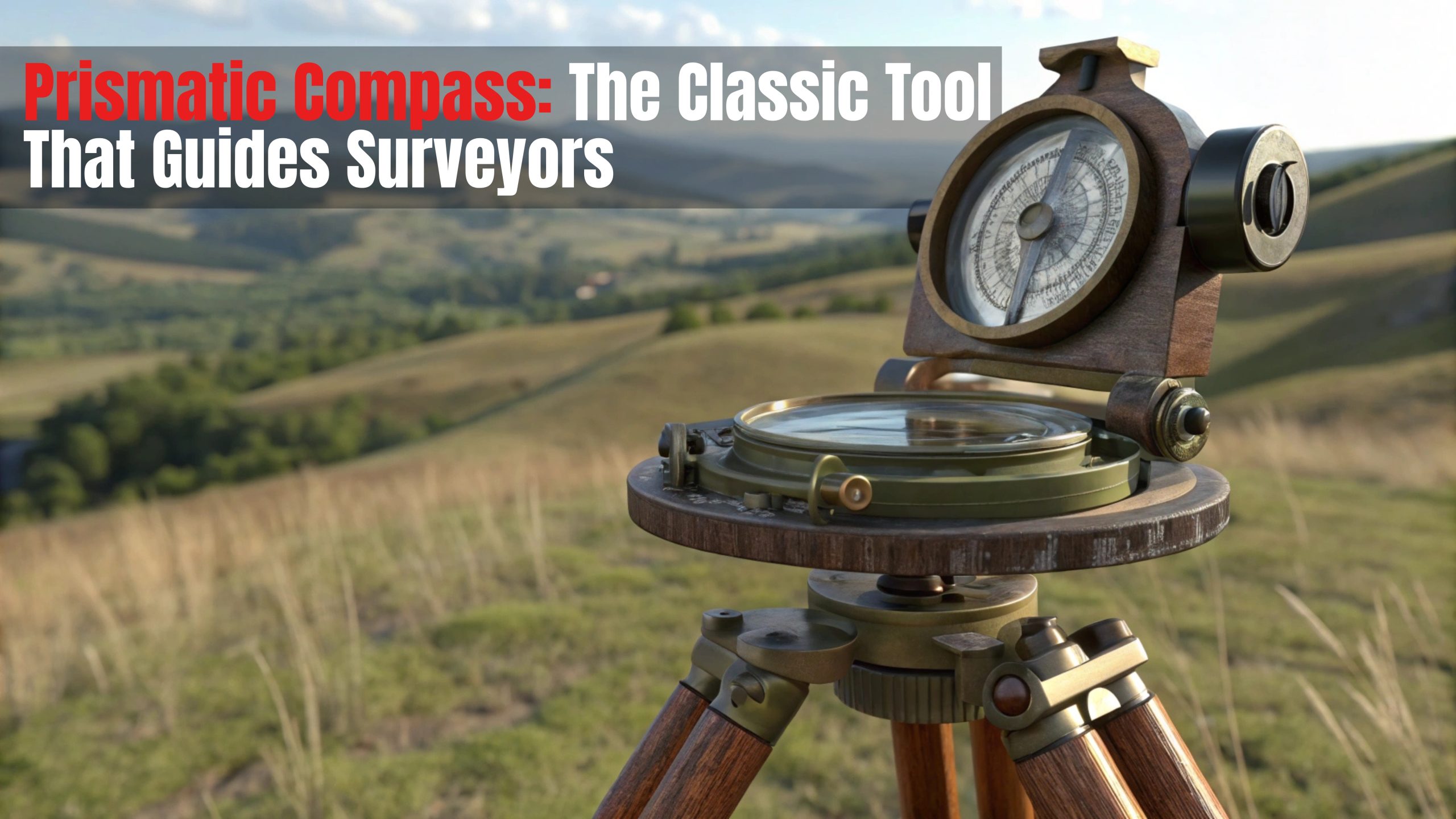
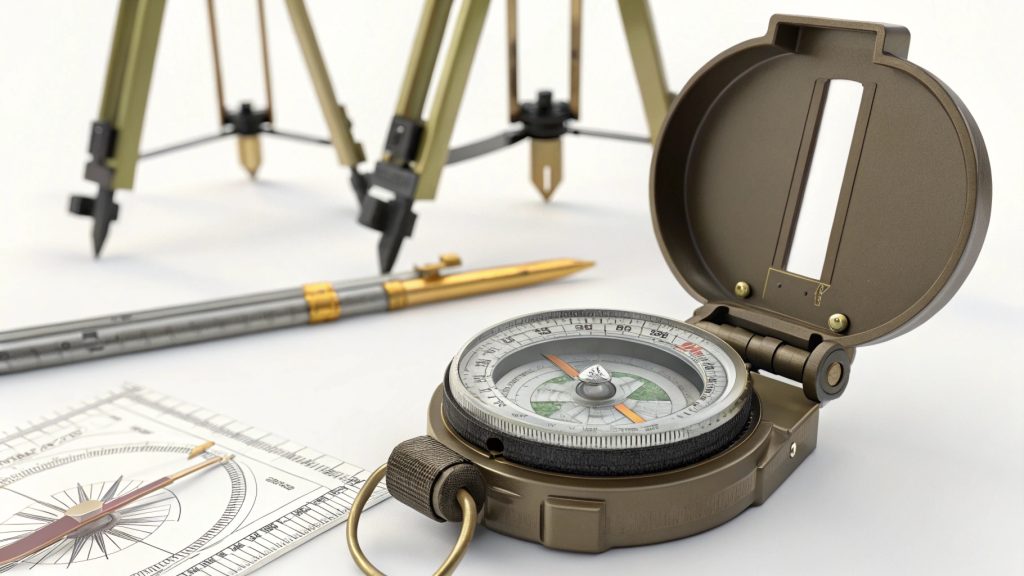
The Prismatic Compass can be described as a tool for surveying that is used to determine horizontal angles as well as bearings. It is made up of a needle with a magnetic field that is aligned with the earth’s magnetic field. It also has a graduated circle which displays angles and readings. The prism allows users to read the measurements while viewing the object.
This double function is what makes the Prismatic Compass efficient and easy to utilize. Surveyors can read bearings directly without the need to perform any additional calculations. The equipment is placed on either a tripod or handheld according to the type of survey conducted.
For those who are new to the field, understanding the mechanism that drives the Prismatic Compass is crucial. It introduces them to the idea of magnetic bearings as well as the concept of directional measurement. The concepts are later utilized in advanced surveying techniques, like Theodolite Survey and digital mapping systems.
Students enrolled in technical education programs, like the best BIM course for civil engineers, can benefit by learning these basics. They can understand the way that real-world data about sites is obtained before it is transformed into models that can be digitally manipulated.
Main Components of a Prismatic Compass
- Magnetic needle
- Gradually shaped circle
- Prism to read measurements
- Sighting vane and object vane
- Tripod Stand (optional)
Every component plays an important part in ensuring precise and precise measurements on the field.
How to Use a Prismatic Compass Step-by-Step (With Real Examples)
The use of a Prismatic Compass requires careful setting and careful observation. The procedure begins by setting the instrument on the point of survey. It could be mounted on an upright tripod or held at a chest level. The compass should be level to ensure that it reads accurately.
Then, the surveyor will see the object they want to study using the vane that is used to see. While doing so they read the results via the prism. The needle’s magnetic field aligns with the magnetic field of Earth and the position of the needle is displayed directly in the circle with graduated edges.
When conducting the boundary study, an expert could employ the Prismatic Compass to find how property lines should be oriented. Through multiple readings at different locations they are able to map the entire boundary in detail.
Similar to route surveys for roads or pipelines, the instruments help identify alignment directions. Professionals who move on to digital workflows via MEP engineering classes or BIM training depend on these field data for precise modelling.
Steps to Use a Prismatic Compass (With Example)
- Install the device on a level surface
Example: Put the Compass on a tripod to point A on an area survey. - Ensure proper levelling
Example: Modify the tripod so the compass remains steady and well-balanced. - The sighting vane should be aligned with the goal
Example: Focus your gaze towards a tree or boundary marker (point B). - Look at the bearing by using the prism
Example: Notice the angle that is shown like 60deg in the direction of north. - Make sure you record the observation in detail.
Example Example: For example “Bearing of line AB = 60deg” in the field book.
These steps guarantee precise directional measurements during surveys.
A Prismatic Compass and. Total Station Which one should You Choose?
The decision among a Prismatic Compass or a complete station depends on the needs. Although both instruments are utilized for measuring, they vary in significant ways. The prismatic compass can be a fundamental instrument for measuring bearings however, a total station can be a sophisticated device that is capable of measuring angles, distances and coordinates electronically.
Its Prismatic Compass is perfect for small-scale surveys, initial site assessments, as well as educational uses. It’s affordable and simple to use, making it ideal for novices and quick field inspections.
On the other side Total stations are utilized to complete large projects in which high accuracy and precision as well as data integration is needed. They are typically linked to software systems to process data and analyze it.
Professionals who are trained in an BIM certification course online understand how the data from modern tools is integrated to create digital representations. But, they also understand the value of traditional tools such as the Prismatic Compass to understand the fundamental principles of surveying.
Comparison Table
| Feature | Prismatic Compass | Total Station |
| Accuracy | Moderate | Very High |
| Cost | Low | High |
| Power Requirement | Not Required | Required |
| Usage | Basic surveys | Advanced projects |
| Data Output | Manual | Digital /Automated |
Each instrument has its individual significance and importance, and the decision to choose one depends on the scale and complexity of the task.
ALSO READ: Isometric Projection: The Drawing Method Engineers Rely On
What Is a Prismatic Compass? Uses, Parts, and Advantages Explained
The Prismatic Compass is a crucial surveying instrument for measuring magnetic bearings. It plays an important role in field surveys in which alignment and direction are essential. Its simplicity of layout and easy to use makes it one of the most commonly utilized traditional surveying tools.
The instrument is typically employed in various applications, such as border surveys, alignment of routes or topographic maps. It is also utilized in educational institutions to teach the fundamental concepts of surveying. Knowing what it takes to use a Prismatic Compass can help students learn the practical skills needed to conduct fieldwork.
In today’s engineering school students typically combine traditional surveying skills with digital capabilities. Students who enroll in the best BIM course for civil engineers will learn the process by which field data collected with instruments such as the prismatic compass is converted to a digital model.
Parts of Prismatic Compass
- Magnetic Needle
- Graduated Circle (Compass Card)
- Prism (for measuring readings)
- Sighting Vane (Object Vane)
- Eye Vane
- Glass Cover
- Lifting Pin and Brake
- Tripod Stand (optional support)
Advantages of Prismatic Compass
- Simple and simple to use
- Lightweight and easily transportable
- Does not require electricity.
- Ideal for field conditions with rough terrain
- Cost-effective in comparison to sophisticated instruments
Common Uses
- Boundary surveys
- Road surveys and pipelines. pipelines
- Initial site investigations
- Training in the field of education and practice
Knowing the benefits and uses that come with the Prismatic Compass allows engineers to choose the appropriate tool for tasks in surveying.
Conclusion
The Prismatic Compass is still a useful instrument for surveys, even during a modern age of digital technology. The simplicity of its operation, the reliability and user-friendly makes it a valuable instrument for beginners as well as experts.
Although modern instruments like complete stations as well as GPS systems provide greater accuracy and performance The Prismatic Compass provides a strong base in surveying concepts. It assists engineers to understand the fundamentals of bearings, direction, as well as field observation.
The modern civil engineering professionals profit from combining traditional expertise with the latest tools. Through programs like BIM certification courses, a BIM certification course online and MEP engineering courses and the best BIM course for civil engineers of all kinds, they will be able to bridge the gap between surveying in the field and digital modeling.
In the end learning the traditional and contemporary techniques for surveying will ensure greater precision, coordination, and a greater efficiency of engineering projects.
FAQs – Prismatic Compass
- What is a Prismatic Compass in surveying?
A Prismatic Compass is a surveying instrument used to measure magnetic bearings of lines with the help of a prism and a magnetic needle.
- How does a Prismatic Compass work?
A Prismatic Compass works by aligning its magnetic needle with the Earth’s magnetic field and showing the bearing directly on a graduated scale through a prism.
- What are the main uses of a Prismatic Compass?
The Prismatic Compass is mainly used for boundary surveys, route surveys, and preliminary site investigations.
- What is the least count of a Prismatic Compass?
The least count of a Prismatic Compass is typically 0.5 degrees, which defines its measurement accuracy.
- What is the difference between Prismatic Compass and Theodolite?
A Prismatic Compass measures only magnetic bearings, while a theodolite measures both horizontal and vertical angles with higher accuracy.
- What are the advantages of a Prismatic Compass?
The Prismatic Compass is portable, easy to use, cost-effective, and does not require power, making it ideal for field surveys.
- What are common errors in Prismatic Compass surveying?
Common errors include magnetic interference, improper levelling, and observational mistakes.
- Can a Prismatic Compass be used without a tripod?
Yes, a Prismatic Compass can be used handheld, but using a tripod improves stability and accuracy.
- Why is Prismatic Compass important for civil engineering students?
It helps students understand basic surveying concepts like bearings, directions, and field measurements.
- Is the Prismatic Compass still used in modern surveying?
Yes, the Prismatic Compass is still used for basic surveys, training, and as a backup tool alongside modern instruments.